Showing posts with label wood-heated hot water. Show all posts

Friday, April 30, 2021

In Praise of the Margin Gem's Waterfront

Things have been ridiculously busy in our lives over the last several weeks.  School has kept me occupied with both substituting and accompanying the choirs; our church has hired a pastor; after a futile housing hunt we prepared our little house here on the farm for him and his wife to live in; and our church is converting a former doctor's office into our new church building.

You will note from the list above that I haven't done any spring gardening or cleaning, and I didn't even put mowing on the list, though the yard is beginning to look like a jungle.  All of these necessary activities have prevented me from posting very regularly.

Through it all, we've still managed to be firing the Margin Gem on a daily basis.  My goal is to have it heat all of our hot water until the end of May, but we shall see.  Lots of factors play into this, such as how much time I have to keep gathering and cutting fuel, how hot the weather becomes, the levels of humidity indoors and out, whether I can keep enough dry fuel ahead, etc.

Today, though, I just wanted to write a quick post to say how truly impressed I am by the water heating capacity of our Margin Gem system.  In something I read or watched or in a phone conversation with Daniel Fenoff of Stoves and More LLC, where we purchased our Margin Gem back in 2011, I remember him saying that during the summer months they lit a fire in their cookstove each morning in order to cook breakfast.  That fire heated enough water to meet their hot water needs until they had another fire in the evening to cook supper.  

With our schedule as full as it has been, we haven't been doing a lot of cooking.  Last night we had a cold supper, for example, and the night before that, all I made was a dish that my niece calls "Bougie Ramen."  As that involves simply boiling water for three minutes, it was far faster to cook it on the electric stove down in the basement.  Thus, what we've been doing is not starting a fire in the cookstove until just before we go to bed.  Once the fire is well established, I put large chunks of wood in the stove and turn the draft down so that the fire will burn all night.  When we get up in the morning, there is a nice bed of coals that I rake together.  I throw some kindling on this, wait a few minutes after it has caught fire, and throw a few more small pieces in.  This fire is sufficient to fry a couple eggs or make French toast, and it tops off the hot water enough that we can shower and wash dishes in the mornings.

(Note: The above firing method of firing the cookstove can create an unduly large accumulation of creosote in the chimney.  In order to prevent that, I have to use the driest wood that I can find.)

You don't have to have a very hot fire in order to heat quite a bit of water.  I think this is due to the large surface area of the Margin Gem's waterfront.

The interior of the Margin Gem firebox.

In the picture above, you can kind of see the waterfront.  It is the whole left side of the Margin Gem's firebox and measures approximately 16" x 12" which results in about 192 square inches of heat exchanging space.  Coupled with a stone-lined 40-gallon Vaughn range boiler, the heating capacity of this system is impressive, I think.

A picture of the Vaughn range boiler before it
was attached to the Margin Gem.

If I were going to level any complaint against this water system of ours, it would be at the mixing valve which tempers the water as it leaves the tank and goes into the house plumbing.  

Our problematic mixing valve.

Sometimes in the middle of a shower (and perhaps it does this at other times too, but we have no way of knowing) it behaves badly, sending the water from very pleasant to too cold to uncomfortably hot for no apparent reason.  We notice that this happens most frequently when the water in the tank is extremely hot.  I believe this little defect to be the result of the fact that it was damaged by the plumber during installation.  While this is annoying, it hasn't proven to be dangerous, and getting it replaced will not necessarily be expensive, but it will be colossally inconvenient.

The longterm weather forecast is for fairly cool weather, so we'll see how long we can hold out until we switch to electrically heated water for the summer.

Friday, October 16, 2020

Economizing with Your Wood Cookstove

In the autumn of 2019, we didn't turn off our electric water heater and make the annual switch to wood heated water and daily firing of the Margin Gem until October 11.   Well, the fall of 2020 has been much cooler here, and with the economic uncertainties of the world today, it seemed prudent to make this transition much earlier.  Thus, we turned off our electric hot water heater on August 30 of this year, and with the exception of running it again for an hour and a quarter on Labor Day, which happened to be hot, all of our water has been heated by the Margin Gem since then.  And because the Margin Gem has been fired daily, the vast majority of our cooking has been done on it too.  This is the earliest we've ever made that transition, and the monetary savings has already been borne out in our most recent electric bill.

This got me to thinking about wood cookstove economics.  If you don't have to pay for your fuel, the wood cookstove can be an enormous money saver.  Yes, buying and installing a woodburning range is quite an investment, but as long as you can harvest and work up your own fuel, you begin to save money starting with the first fire you use in your range.  In the face of dire economic circumstances, I think a woodburning cookstove can be a tremendous tool for making a household as cost-efficient as possible.  Below you will find a list of some ways to take advantage of the money-savings a woodburning cookstove can provide.  Links are provided to posts which go into more detail.

A). Use a Wood Cookstove to Heat Domestic Hot Water

Shutting off our electric hot water heater shaves a minimum of $20 from our electric bill each month.  I figure that by the end of this calendar year, having our water heated by the Margin Gem will have saved us at least $1300 over the life of the system so far.  This means that the extra cost of the range boiler, the water jacket, and the specialized plumbing has paid for itself, and there are many years of continued service left in them.  If your water system and local codes will allow the installation of a range boiler system on your woodburning cookstove, I highly recommend it.

However, even if hot running water from your cookstove is not an option, heating water with your cookstove can be accomplished in a number of other ways.  Most cookstoves have a water reservoir option for heating water that is manually drawn from the stove.  In my experience, water heated in the range's reservoir is much hotter than the temperature at which most people would set their automatic water heaters.  Thus, a water reservoir that only holds five gallons actually provides far more hot water than its capacity because the super-heated hot water will have to be tempered with additional cold water before it can be used.


In addition to a reservoir, water can be heated in vessels on top of the stove.  The most commonly found is the old-fashioned teakettle; its spout makes using the water from it quite convenient, too.  You'd be surprised how many dishes can be washed and rinsed in a mere gallon of boiling water that has been diluted with cold water to a usable temperature.  You may find it impossible to turn off your automatic water heater, but you can still save a little money by supplementing it with a little hot water here and there from your wood cookstove.


B. Take Advantage of the Home Heating Capacity of Your Woodburning Range

The woodburning cookstove can be a powerful heater.  In fact, new ranges even come complete with BTU ratings and information about the number of square feet that they can heat.  I'm kind of amused by that because when you look at old cookstove advertisements, the heating capacity of the range is never mentioned.  Instead, they were always about the quality of the stove's construction, its fuel efficiency, and ALWAYS about its superior baking capabilities--even though history is replete with stories about cookstoves being the sole source of heat for many homes.  Nowadays, advertisements tout the cookstove's heating capacity, but they don't say much about how well a stove can bake.  Oh, the pendulum swings we see in life!

To maximize the heating capabilities of your woodburning range, keep the cooktop as free from extra kettles and miscellaneous as possible in order to let the heat radiate into the room.  Open that oven door, too!  The greater the surface area that is exposed, the greater the heat sent into the room.

Also, a strategically placed fan can move the heat through your house better, making you feel warmer when you are not standing right next to the stove.  You can see our wood stove fan to the right on the Qualified Range below.  For more details about getting the most heat from your wood cookstove, visit this post. 


C) Use Your Woodburning Range Instead of Your Small Kitchen Appliances

Conventional kitchen wisdom is that electric countertop appliances use less energy than utilizing your kitchen stove to accomplish the same cooking task.  This is the complete opposite of what happens when your kitchen stove is a woodburning range.  Here is a list of small electrics that can stay in the cupboard when the cookstove is in use:

The Electric Skillet
French Toast cooking on the wood cookstove.

The Toaster

For a very lengthy post about the many ways you can toast bread on a wood cookstove, visit here and here.

The Microwave

In the pictures below, you can see me using the warming ovens on both the Riverside Bakewell and the Margin Gem to soften or melt butter and to defrost homemade applesauce.  Susan Fenoff, in her video about using wood cookstoves, calls the warming oven her "Amish microwave."


The Waffle Iron


Waffles are delicious, but waffles cooked on a wood cookstove are a step above in my opinion.


The Slow Cooker or Crock Pot

There are actually many ways that you can use your cookstove as a slow cooker/crock pot, but the method discussed in this post creates the most similar heat by using your wood cookstove's oven with the door open.

The Electric Wok

I don't know anyone with an electric wok anymore, but I know they exist.  However, you don't need one because you can cook wonderful Oriental food in a stovetop wok on a wood cookstove.

The Insta-Pot

I am almost afraid to point this one out since I know many people are in love with their Insta-Pots, but you can use a pressure cooker on top of a wood cookstove quite easily.  Sure, it won't do all of the things that an Insta-Pot can do, but you can pick up a cheap used pressure cooker in second hand stores very easily, and the food possibilities are endless and fast.


My favorite thing to cook in a pressure cooker is tougher cuts of meat, but you can quickly cook vegetables, rice, and even hot cereals in them.

The Popcorn Popper

You'll need a very hot fire, but you can easily pop popcorn on top of a woodburning cookstove, and don't worry about having a fancy hand-cranked popper.  You can get popcorn that is every bit as delicious by shaking it in a plain old saucepan.

The Deep Fat Fryer

Of course you have to be careful, but the wood cookstove is great for deep fat frying.  Historically, wood cookstove cooks favored frying over baking because it is easier to control the temperature of the oil than the oven.  In the picture above, you see homemade chicken nuggets frying on the Margin Gem, and in the post I wrote about them, I discuss the details and cautions that are necessary to deep fat fry on a wood cookstove.

Some readers may look at the above points and note that specialized equipment is sometimes necessary.  For example, in order to bake waffles on your wood cookstove, a stovetop waffle iron is a requirement.  They are increasingly hard to come by in antique stores, and the price has risen exponentially in the last twenty years.  However, new stovetop waffle irons are still available from Lehman Hardware, and at anywhere between $30 - $60, they are competitively priced with new electric ones.  Stovetop waffle irons can be used on gas and electric coil-type modern ranges too, so they are not a bad investment when your countertop waffle iron gives up the ghost.

D. Use Your Wood Cookstove in Place of Other Non-Cooking Appliances

Your wood cookstove can do the jobs of other energy consuming appliances as well.  Here is a list of non-cooking appliances that you can unplug:

The Scentsy® Warmer

Wonderful aromas can be sent wafting through your home by simmering potpourri on top of your wood cookstove.  You'd be amazed how many things resting quietly in your spice rack can be put to use as perfumes for your house without having to spend a ton of money on a ceramic warmer and individually packaged lumps of colored soy oil.

Still, if the colored lumps are your preference, you can melt them in a pan on the cool end of the range just as well as in the expensive warmers.  The same can be said of candles in glass jars.  When we get down to the bottom of a candle which has a scent we really enjoy, instead of lighting the candle, we just put the glass jar as far away from the fire as possible.  The warmth of the stove still melts the wax so that it can emit the scent.  Eventually, the aroma wears away and the candle can move onto its next stage of usefulness, but we've taken all possible advantage of its perfume.  NOTE: Just be sure not to put any glass candle vessels where the heat of the fire is so intense that it could break the glass.  That could be a disastrous fire hazard!

The Clothes Iron

I know, I know.  Some of you are laughing because it's been years since you've ironed any clothes at all.  Well, more power to you.  But for those of us for whom ironing is still a very real chore, ironing can still be accomplished with a wood cookstove as your source of heat.  That's all I'll say about that here.

The Clothes Dryer


American households have to be the worst in the world about wasting energy to dry clothing.  Oops!  Sorry, I jumped up on one of my soapboxes there for a second.  Seriously, though, a clothes rack placed near the wood cookstove can speed along the drying process for freshly laundered clothes.  In the past, woodburning ranges were even equipped with rods for drying towels, mittens, and socks.  Cookstoves can still be used to cheaply and quickly dry clothes.  The double advantage in this is that your can also unplug your home humidifier if you are hanging your clothes to dry indoors.

E. Eat Leftovers

Reducing food waste is one of the easiest things a household manager can do to save money.  In the future, I hope to write a series of posts which give hints and recipes for making leftover foods into entirely new dishes.  I will admit that reheating leftovers is the primary function of our microwave oven, but there are many more tasty ways that leftovers can be reheated or re-made using the wood cookstove.  For example, instead of tossing mashed potatoes in the microwave and having them come out smelling unappetizing and looking no better, making mashed potato patties requires only a little extra effort, and the end product is three times as delicious.

Two posts that I already have which deal with leftovers include one about how to use leftover roast beef and gravy that is very good.  However, if you are really serious about stretching your grocery dollar, the most economical food discussed on this blog is definitely pot-au-feu.

A bowl of Pot-a-Feu.

Literally translated from the French, pot-a-feu means "pot on the fire."  It is as delicious as you want it to be, it is never the same twice, and it is only feasible on a wood cookstove.  

In short, to get the largest financial return from a wood cookstove, make it the energy center of the home.  This is most certainly the way our ancestors used their kitchen ranges, and if one of today's households is blessed with a working wood cookstove, it still has every capability of serving in that capacity.

So, dear readers, what have I missed?  Fill up the comments below with what you do, what you remember your ancestors doing, or what you have heard others did to save money with a wood cookstove.  I'm anxiously awaiting your feedback.

Thursday, September 19, 2019

Answer to Request for a Diagram of the Cookstove Hot Water System

Yesterday, I received a request for a diagram of our hot water system from a reader who is installing a similar system.  I apologize for my extremely poor artistic ability, but here it is.  I put together two views since the plumbing is divided up that way.  Below the diagrams, you will see a key to the red letters in case the words on the diagrams are too difficult to read. The scan is long, though, so you'll have to scroll down through quite a bit of white space in order to see the key.


A. Temperature Pressure Relief (TPR) Valves
B. Hot Water Line which exits the top of the waterfront on the cookstove, carrying hot water into the top portion of the boiler.
C. Check Valve which allows cool water from the bottom of the boiler to only flow toward the stove, not vice versa.
D. Cool Water Line through which cool water from the bottom of the boiler flows into the bottom of the waterfront on the cookstove.
E. (left side diagram) All TPR valves are connected to a common drain pipe which empties toward the floor drain in the basement.

E. (right side diagram, sorry!) Hot Water Pipe exiting the top of the boiler.
F. Tempering Valve-Hot water from the top pipe enters this valve and is mixed with cold water from the supply line in order to have control over the temperature of the water in the household system.
G. Cold water enters the boiler at the mid point opening.
H. Hot Water Line to household system.
I. Cold Water Supply Line

Here are some actual pictures of the system:


I hope this answer's the reader's question.  If not, let me know in the comments what more I could help with.  The system certainly works well!

Friday, September 21, 2018

The Beginning of the Full-Time Cookstove Firing Season 2018-2019

Well, today was the day.  Yesterday (and for several days before that), our high temperature was in the nineties.  After a terrific rain storm last night, a cold front went through, and today our high was in the sixties.  With lows in the forties tonight, tomorrow is not supposed to reach seventy degrees.  The long-range forecast has a few seventies in it, but nothing too terribly warm.  Thus, after Nancy's shower this morning, I turned off the electric hot water heater and our season of firing the wood cookstove every day has officially begun.  I do believe that September 21st is the earliest we have ever done this.

Supper tonight was just chips and fresh salsa, raisins, and apples, but while the fire was going to heat some dish and laundry water, I cooked some more red raspberries for jelly. 

Another cooking job that I had been saving was the sugar pot from our Monday Market baking.  When I turn out a pan of sticky rolls, we catch the caramel syrup that runs off them in jelly roll pans beneath the cooling racks.  That is then scraped into a stockpot, and at the end of the season I make pancake syrup out of it.  It is quite delicious, and this way the sugar is not wasted.

The first step in that process is to add water to the pot and bring the whole thing to a rapid boil.  Tomorrow I will skim the butter and cinnamon layer from the top, make sure it is the right consistency, bring it to a boil again, put it in canning jars, and seal them in a hot water bath.

The kettle of red raspberries on the back of the
firebox and the sugar pot at the front.
This was not the first fire we've had in the stove this season, but with the electric hot water heater turned off, we are now committed to daily fires.  I'm really looking forward to it!


Monday, May 28, 2018

Waving the White Flag on the 2017-2018 Heating Season

Well, after having a fire in the Margin Gem every day since Sept. 27, 2017, which was when we turned the electric hot water heater off for the season, we finally decided to tie a bow on the 2017-2018 wood heating season this morning.

I know several of you just gasped and shook your head at the discovery that over the last few days we had still been using the wood cookstove daily when our temperatures have been soaring into the upper nineties, even reaching 100 on Saturday.  Other readers who know me just had their suspicions regarding my sanity confirmed with this revelation.

To use the cookstove exclusively for hot water from Sept. 27 - May 27th ties our record which was set during the 2013-2014 heating season. During this time, not only was all hot water heated with wood, but I think all but about five of the meals which were cooked at home were also cooked over wood heat.  One of those five meals was a regular meal a couple of days ago.  The others were just boiled eggs or frozen pizza.

Some of you may be wondering how we were able to use the stove for so long in such warm weather without suffering too much.  Many factors contributed to our endurance:

1) Our century-old farmhouse was designed to have a woodburning cookstove in the kitchen.  This is a major factor in our ability to use the stove in warm weather.  The kitchen has six doors that open into other areas of the house, but all of these except for the pantry doorway can be closed in order to keep the heat out of the rest of the house.  The large east windows are double-hung, so the top sashes can be lowered in order to facilitate heat escape.

The kitchen windows with the top sashes open.

Also, since it is a two-story house and the stairway opens into the kitchen, we can open the upstairs door and let a great deal of the heat escape up the stairs where a fan was positioned in a window at the top of the stairs blowing hot air out of the house.

When our kitchen re-model is finished, yet another way to exhaust heat from the stove will be restored, so stay tuned for another blog post about that.

2) Our house is surrounded by large old shade trees.  Our shade is not as dense as it once was, but we still have a lot of it, and this makes our house stay much cooler in general.

3) We don't have to have a long-running fire in order to have sufficient hot water to meet our needs.  A fire which burns briskly for less than an hour creates more than enough hot water for a good shower in the morning. This also means that I used small pieces of wood which burned hot but not long.

4) We closed the "hyper-heat" reservoir damper and often opened the oven damper so that the stove itself wasn't radiating so much heat into the kitchen.

The reservoir damper in the open position.  When it is closed,
it is in the vertical position.

5) I would also fill the teakettle and our 40-cup coffee pot and put them directly over the firebox while the fire was burning.  These, coupled with the water in the reservoir, supplemented the hot water in the boiler and provided enough hot water to wash dishes and do a little laundry when necessary.  Of course, water in the kettles and the reservoir was used in the wringer washer and in hand washed laundry only.  It would have been difficult to get it into the high-efficiency front-loader. Anyway, heating water in this way absorbed the majority of the BTU's which would have emanated into the house from the cooktop.


6) Though we had some extremely warm days, the nights were still getting cool, so we could pull all of the heat out of the house during the night. Then we would shut the windows in the morning before the outdoor temperature got warmer than the indoor temperature.

7) The weather we have been having has been extremely dry.  This is not a bit good for any of our crops, but it made it so that the high temperatures were more bearable than they usually are in our area of the country.

Q. So what changed between yesterday and today?

A. Last night the outdoor temperature did not fall as low as it has been.  It was 67º outside when I woke up a little before 6:30 a.m.  The living room temperature was still at 77º.  This was only four degrees lower than the high temperature that we observed yesterday afternoon.  I always kind of figure that 70º is roughly our breaking point for comfort.  If the outdoor temperature doesn't dip sufficiently below that during the night,  we are uncomfortable.

Thus, after draining the electric water heater and flushing it out (the water in it always sours), we are back to paying for hot water, and I even broke down and turned on the air conditioning.  I'm feeling pretty weak today, but I'm comfortable!

Now, don't think I won't have anything to blog about over the next few months.  My goal is to get the summer kitchen moved from the end of the driveway up to the north side of the house within the month (we'll see if that happens), and I have a raft of wood cookstove literature to review, too, so check in frequently.  We'll be in touch!

Tuesday, February 20, 2018

Woodburning Cookstove: A Prepper's Necessity

When one thinks of major disasters, usually events like tornadoes, hurricanes, blizzards, earthquakes, wildfires, or tsunamis come to mind.  Of course, major disasters can take the form of man-made catastrophes as well, such as terrorist attacks or economic depressions.

If your home is completely destroyed in a disaster such as these, there is relatively little you could have done ahead of time in order to mitigate the aftereffects of such an event.  However, many of these calamities can leave your home untouched or damaged but still inhabitable.  When this is the case, whatever steps you have taken to prepare for a major disruption in your normal life will be greatly appreciated.

Each of the disasters listed above--except perhaps economic depression--carry with them the possibility of an extended electrical power outage as a part of their destruction.  I, for one, find our American dependence on electrical power absolutely frightening.  Fortunately, a power outage is something people can prepare for.

Power outages take many different forms.  Some can affect just one house or only a few houses.  Others can be widespread blackouts.  When you think about it, though, the number of homes involved in the power outage is not nearly as important as the length of time the power outage lasts.  A blink of only a few seconds is a mere blip in the vinyl that makes you reset the clock on your microwave oven.  The power outage of an hour could be an annoying inconvenience that alters your plans a bit.  An outage lasting more than two days can have disastrous consequences on your household budget if the food in your home freezer is spoiled.

In contrast, the power outages that I think about being prepared for are the results of disasters of a much larger scale, such as a major storm which could take out the electricity for a period of weeks or a solar flare or EMP (manmade or otherwise), which could alter the use of electricity for the foreseeable future on a scale that we have trouble even imagining.

Now, I don't consider myself a "prepper."  I don't have anything against preppers, but I know that in the event of a long-term, large-scale blackout like an EMP, I'm on the short list of people who will die soon because of my utter dependence on blood pressure medications.  I'm actually okay with that since having Jesus Christ as my Savior makes the next life look far better than this Earthly one anyway, and if we're looking at a catastrophic compromise of the electrical grid, I don't want to stick around to watch American society implode.  The problem is that I could live a headache-ridden existence for quite awhile since it's not up to me.  Thus, I can't help but think and plan a little bit.

If a power outage of this magnitude occurs, I think that having and knowing how to use an installed woodburning cookstove is an essential preparedness item.  Here are my reasons:

1. A woodburning cookstove can be used indefinitely.
Many people's answer to energy independence is a propane range.  I see this all the time in homesteading/preparedness videos and blogs as well as in homesteading magazines.  If you live in an area where a woodburning range is an impossibility, then a propane cooking device of some kind is certainly a better option than no option at all.  However, in a situation such as an EMP, whatever propane you have in your possession at the time of the disaster is the extent of the propane you will probably have for a very long time.  Thus, you cannot cook over propane indefinitely.

What waffles for supper might look like at our
house during an extended power outage (as long
as we still have lamp oil, of which I keep gallons
on hand).

With a woodburning cookstove, you will be able to cook as long as you are able to procure fuel.  Keep in mind, however, that if you are completely dependent on your chain saw and gasoline log splitter, you are not much better off than those with propane ranges.  For this reason, it is best to keep a manual set of wood-gathering equipment at hand.  The good news about these items is that they can be procured for little money.

Also, a wood cookstove can burn a number of different bio-fuels, so unlike a propane range which can only burn one type of fuel, you have several more options with a woodburning cookstove.

2. A woodburning cookstove can be used to heat your home and your water.

It is true that you can heat your water with a propane range, but heating your home with one is a dangerous proposition because of carbon monoxide.  The other advantage to a woodburning cookstove in this instance is that the fire that is cooking your food can be warming your home and your water at the same time, whereas heating water on a propane range will involve increased fuel consumption no matter how you look at it.

While I'm talking about water, let me take a moment to admit that I feel strongly that this is our achilles heal on our farm.  Though we are still using the same water system designed by my great-grandparents where gravity delivers water to the house and barns from an in-ground cistern on top of the hill behind the house, we no longer have a windmill to pump the water from the well to the cistern.  That situation is something I would like to rectify sooner rather than later.  At least, while there is water in the cistern, our wood cookstove hot water heating system allows us hot and cold running water without the aid of any electricity whatsoever.

After a long day of dealing with the life changes that a major, long-term power outage created, a hot shower would feel really good.

3. Your diet during a large-scale emergency won't have to change so drastically.

Most of the things I've read about preparing for a major, long-term catastrophe advise that keeping as much normalcy as possible is good. This advice extends to menu-planning, too, especially if you have children in your family.  In the face of the many day-to-day challenges which will arise from living without electricity, people will take comfort in being able to sit down and enjoy a familiar meal.

A wood cookstove can do anything that a modern range can do with the only exception being broiling in the fashion that we are familiar with where a heating element or flame is above the food. This means that wood cookstove owners will be able to cook just like they had been doing before the power went out.  The problem will be that in a situation like an EMP, the availability of familiar foods will be altered.

For this photo, I opened the firebox door to
prove that I was truly baking the waffles on the
wood cookstove (some people doubt this without
seeing the fire).  You will notice that this photo
was taken after Nancy had her waffle on her plate.
She doesn't like my homemade pancake syrup--
hence the bottle of Log Cabin syrup next to her
plate.

4. A wood cookstove will allow you to prepare food for long-term storage.

As mentioned above, a long-term power outage can cause you to lose the food in your home freezer.  Of course, when you see that the freezer is no longer maintaining a safe temperature for frozen foods, you might begin to consume as much of the food as possible.  However, our freezer is a 25 cubic foot model, and eating all the food that we store there would be very difficult to do in a short amount of time.  To be prepared to save as much of that food as possible, I always maintain a large supply of canning jars and lids.  Neither of these will do me any good, though, unless I've got a woodburning cookstove to can on.

A word or two about canning lids in a long-term disaster:  We buy our canning lids in bulk sleeves from the Amish.  They are much more reasonably priced than buying them by one dozen boxes.  This means that we usually have several dozen canning lids on hand at all times.  However, these are single-use lids.  In the event of a major catastrophe where they would no longer be in production, my supply will dwindle in a hurry. Recognizing that, I have a small collection of Tattler re-usable lids, and a very large collection of zinc and glass lids and rubber sealing rings which are also re-usable.  In my library of vintage canning books, explicit canning instructions for these lids are also maintained, and I have been practicing with them.

5. A woodburning cookstove is more convenient than cooking outdoors or cooking on a heating stove.

Some readers may be thinking that as long as they have a woodburning heating stove, they can cook, heat, and can with that.  This is true, of course, if your heating stove is designed in such a way as to make that possible (our Jotul is not).  When I was growing up, we only had a woodburning heating stove, and I tried cooking on it, and I've always been impressed by what Misty Prepper could do on her Fischer, but a woodburning cookstove is far easier to cook with than a heating stove.  At a time when virtually every other task could be more difficult than usual, any little convenience will be appreciated.


No doubt some of my readers have had their suspicions about my sanity confirmed with this post.  Others will think I'm woefully ignorant about what prepping really entails.  I'd like to hear from both.
What reasons have I missed?  As always, I welcome you to use the comments section below.  Thanks for reading!

Tuesday, October 17, 2017

A New Experience with Wood Heated Hot Water

On Sunday, something new happened with the water heating system that is attached to Marjorie the Margin Gem cookstove.

Wait.  Maybe I should rephrase that.  What happened really wasn't new, but how it affected me was new.

Are you confused already?  If not, you should be.

Let's see if I can explain this.

First, it is important to understand how the hot water system works.  Cold water enters the middle of the boiler on its north side.  Cold water exits the bottom half of the tank through the lower pipe on the south side and enters the waterfront (or water jacket) in the Margin Gem.  The waterfront is a hollow box on the left side of the firebox where fire brick would ordinarily be.

An old picture of the Vaughn range boiler before
it was connected to the Margin Gem.
A look inside the firebox of the Margin Gem.
The top of the picture is the back of the firebox.
You can see that firebrick lines the back, right side,
and lower half of the front under the door.  The
black left side is the waterfront.
Just like hot air, hot water rises, so when the water in the waterfront gets hot, it rises through the top pipe into the upper part of the range boiler.  It is displaced in the waterfront with cooler water from the bottom of the boiler. This circulation between the stove and the boiler eventually results in the whole tank being filled with hot water.  Since it is only natural convection that is moving the water and no pump, it is called a thermosiphon.

When a hot water faucet is opened somewhere in the house, the hot water exits the top of the boiler, passes through a mixing valve which cools it by adding cold water if necessary, and then travels to its point of use.  The mixing valve allows us to manually adjust the maximum temperature of the hot water delivered throughout the house.  We have always kept this at its highest setting, however.

We officially turned off our electric hot water heater for the winter season on Sept. 27th.  Since then, all hot water used in our house has been heated by wood.  Of course, at this time of year the temperature has not been cold enough to demand that a fire be burning in the range all the time.  Having a fire in the morning to make breakfast and at night to cook supper is pretty much sufficient to supply us with enough hot water for our household needs unless we are doing quite a bit of laundry.

Because of this cyclical fire schedule, we often have times when the water in the Vaughn range boiler is hot, but the fire in the stove has been reduced to relatively cool coals.

This means that the water in the tank can be hotter than the water in the waterfront inside the firebox of the range since the firebox is lower than the tank and hot water rises.

A picture showing the height of the tank relative
to the height of the waterfront in the firebox of
the Margin Gem.
Thus, when the fire is rekindled, it takes a while for the water in the waterfront to heat up.  When it finally gets hot enough to start the thermosiphon again, it often does so with an audible whoosh.  If both the boiler and the stove are cold, the thermosiphon starts so gradually that you don't hear a thing.

So what happened on Sunday?  Well, we were not home for noon dinner, so the breakfast fire was allowed to go out.  After getting dirty while working outside in the afternoon, I needed a shower before we left for evening Bible study.  There was plenty of hot water in the tank for my shower, but we were in a frost warning for Monday morning, so I knew we needed a fire to not only keep the house warm enough but also to heat the water for showers the next morning.

I re-lit the fire and then immediately jumped in the shower.  The water in the boiler was at a comfortable temperature for showering since the fire had been been basically out for over six hours at that point.  I didn't have any cold water turned on at all.

I could feel the water getting a little cooler throughout my short shower, but that is normal for both the electric and wood-fired water heating systems. Then toward the end of my shower, the water suddenly became quite hot. It took me a few seconds to realize that the water in the waterfront had finally become hot enough to restart the thermosiphon, and since I had only turned on the hot water valve in the shower, I was feeling the full effects.

The temperature change was not so extreme that I was burned or anything, and if we didn't have our mixing valve set so high, I probably wouldn't have even noticed it.  However, I wanted to share this experience here so that if any other people use a water heating system that operates like ours, they can be aware that an event like this is possible.

If you heat your domestic hot water with a waterfront in a woodstove of any kind and have had a similar experience, please tell about it in the comments section below.

Saturday, October 15, 2016

The Best Laid Schemes o' Mice an' Men Gang Aft Agley

Well, my last post ended up being a little pre-mature.  We had the stove fired from Wednesday, the 28th to Monday, Oct. 3rd.  I had planned to work on cutting wood after school that Monday, but my brother had other plans.  He had a bunch of alfalfa hay down, and we were due to get quite a bit of rain the following day, so I ended up helping him put up hay instead of cutting wood.  That meant that I had to let the fire go out and restart the electric water heater.

The rest of that week ended up being quite wet, so it wasn't until Friday, the 7th, that we ended up starting the stove again.  Marjorie has been our sole source of hot water since then.  She has been busy cooking and baking too.

Now to get down to more important posts!

Wednesday, October 28, 2015

Update on Hot Water System Maintenance

In my September 11, 2014, post about maintaining our dual hot water systems, I noted that we have trouble with the water in the electric hot water heater souring over the winter.  I had written that my goal last winter was to cycle cold water through the electric water heater once per month by using it for laundry.  I had hoped that this would prevent the water from souring and would thereby make the late spring ritual of putting the electric water heater back into service much easier.

Unfortunately, after writing that post, I totally forgot my good intentions until November, at which point the water in the water heater had already soured.  There was no point in doing anything until spring then.

This year, I decided to do better.  I wrote in my Sept. 30th post that I had turned off the electric water heater that day.  Usually, when I do this, I use the last of the electrically heated hot water by doing laundry or taking a shower just so I don't feel like the energy used to heat it was wasted.  This year, I thought that maybe if I didn't use the last of the hot water, it wouldn't sour as quickly.

No dice.  Two weeks after turning off the electric hot water heater, I decided I'd flush it out by using my intended laundry method that I wrote about last year.  I set all the valves appropriately and discovered that the water had already soured!  Usually, this doesn't happen nearly as quickly as it did this year, and what is more baffling to me is that it has never happened in the wood-heated system.  This last part is doubly confusing when I admit to you that the Margin Gem was not fired a single time for a space of nearly two months during the summer.  I don't get it.

Wednesday, September 30, 2015

The Beginning of the Season

Gave Marjorie the Margin Gem a partial bath tonight.  Turned off the electric hot water heater (hopefully it will remain off until May), and cooked steak and potatoes on the woodburning cookstove.

The kettle on the rear half of the firebox is from Nancy's
grandma.  She explained to me that it was so black on the
outside because she used to remove the lids over the fire
on her Montgomery Ward cookstove and place it directly
over the flames.  The grill pan in the front was a Christmas
gift from Nancy last year.

We've used the Margin Gem occasionally over the summer, but with a cool forecast for the foreseeable future, the daily firing season has begun.  I've got seven other posts started; now if I can just find the time to complete them!

Thursday, September 11, 2014

A Little Information about Maintaining Dual Hot Water Systems

The trees and the grass in the lawn are still arrayed in the deep greens of late summer, but the corn and beans have begun to turn here, and my nephew (four years old) announced last weekend that harvest is coming soon.

He is indeed right.  The weather turned sharply cooler this week too, so my thoughts are turning toward more regular use of the cookstove.  One of the aspects of having the stove steadily fired that I'm really looking forward to is having it supply our hot water.  I'm looking forward to this because it results in such a savings on our electric bill and because the water that comes out of the tap is so much hotter than what we have our electric water heater set at.

Having dual hot water systems creates for us a unique set of maintenance routines.  Last year, we turned our electric hot water heater off in late September and didn't turn it back on again until late May.  It was the second heating season in which we had turned off the electric hot water heater for an extended period of time.

Before we had installed the Margin Gem with the water jacket system, I was telling my uncle about our plans to shut off our tank-type hot water heater during the winter.  He didn't think this was a good idea at all.  He works as an electrician and has seen a number of vile occurrences in people's homes and said that the inside of a turned-off water heater is the beginning of all kinds of nasty things.  I, however, am unwilling to heat water that we are not intending to use, so I went ahead with turning off the electric water heater. 

What has happened each winter, though, is that the water in the electric hot water heater does sour after about the third month of it being off.  This is not a humongous problem, however.  Both the electric hot water intake and supply lines are equipped with gate valves about a foot above the water heater, so those are both shut off.  When we are far enough into the spring that we are going to use the electric hot water heater, I drain and flush the tank, let it fill again, and turn it on.  Initially, the water does have a slightly objectionable smell to it.  After the water heater has been on for a couple of days, I completely empty the tank again, but since it is hot water this time and I am so frugal, I empty it by washing clothes in hot water in the top-loading automatic washer and the wringer-washer.

Now, because I fear the same situation happening in the water heating system attached to the cookstove, I make sure that we use the Margin Gem at least once a month during the summer season.  We make sure to switch the valves in the water lines so that the water heated by the cookstove is used, thereby circulating fresh water into the system.

I don't want the water in the wood heated system to sour because there is no easy way to drain the system.  The Vaughn range boiler has a tapping on the very bottom of the tank which would have been ideal for a drain valve.  However, due to the low height of the legs on the bottom of the tank and the fact that our tank sits on a marble slab, the plumber could not attach a fitting to the bottom of the tank. 

A photo of our range boiler before it was attached
to the Margin Gem range.

I think that what I'm going to try to do this winter is to occasionally circulate fresh water through the electric hot water heater by setting the top-loading automatic washing machine to the hot water cycle, but washing a load of clothes in the cold water that would come from the turned-off water heater.  I can't use the high-efficiency washing machine in this scheme because it senses the water temperature and heats what has come into the washer to the temperature that it desires according to its setting.  Hopefully, this plan will alleviate the easy but inconvenient task of draining and flushing the electric hot water heater in the spring.

Of course, we use well water here on the farm.  What I'd like to know from my readers is whether this situation as I've described it would happen to people whose homes are served by chlorinated water.  Does chlorinated water ever sour in a turned-off water heater?  If you have a range boiler system which is hooked up to a chlorinated water supply, are you able to leave your wood-fired hot water system unfired for the entirety of the summer without any adverse effects?  Please let me know by utilizing the comments section below.  Thanks for your help!


Monday, May 26, 2014

Optimizing the Hot Water from Our Wood Cookstove

A few Saturdays ago, I was in a hurry to get as much laundry done as quickly as I could because I thought that the potential for rain was going to limit the clothesline drying time.  As I have said before, the range boiler on the Margin Gem has no trouble keeping up with the hot water demands of the high efficiency front loading washing machine.


The problem is that cycles on that machine take just short of three years to complete, and I can get a lot of laundry done in very short order with a wringer washer.  Nancy needs her morning shower, though, and I've mentioned before that she is rather passionate about how hot her shower needs to be.  The recovery time on the water jacket/range boiler system is not as quick as on an electric or gas hot water heater, so I pulled out my old wash boiler.

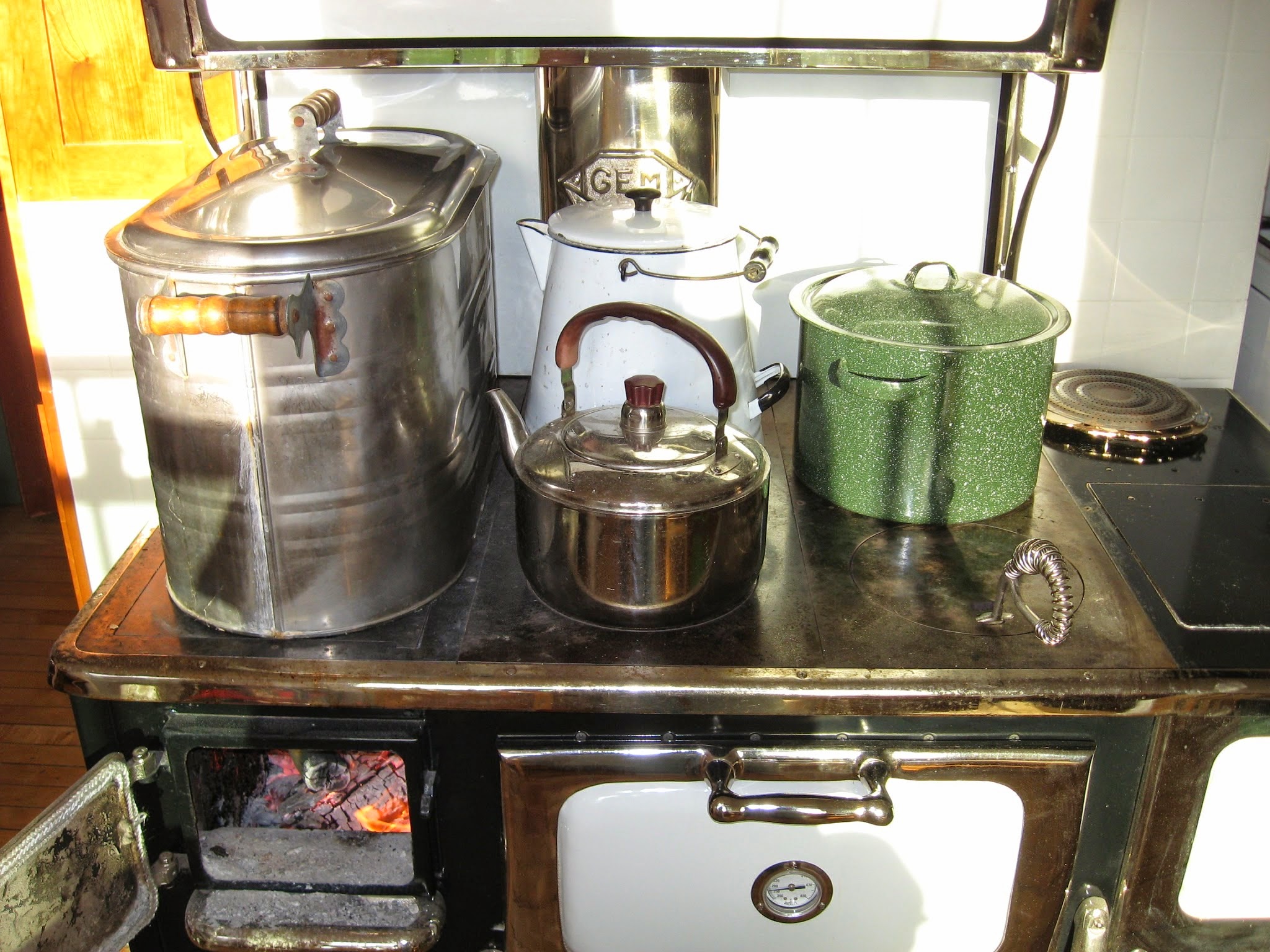
I bought this stainless steel boiler at Walnut, Iowa, over a decade ago.  I chose it because it was in good shape, had a tight fitting lid, and was made of stainless steel.  I haven't used it very often (probably not often enough to make it worth the price I paid for it yet), and this was actually the first time that I used it on the Margin Gem.  Since the Margin Gem has both the reservoir and the hot water jacket, I hadn't felt the need to use it for quite a while.  However, the Qualified range was not equipped with either of these methods for heating water, so the wash boiler used to come in much handier.  One of the reasons that we chose the Margin Gem, though, was because the depth of its cooktop would accommodate this piece of equipment.

The capacity of the wash boiler is approximately ten gallons, so it is about double the size of the water reservoir attached to the right side of the Margin Gem.  I filled it to the top with cold water from the tap.  The water was entering the house at approximately 54 degrees Fahrenheit.  I had built a brisk fire in the stove and put the boiler directly over the firebox.  As you can see from the picture, I also had filled the teakettle and the 40 cup coffee boiler and put them next to the boiler, and the little green water bath canner had some water remaining in it from canning apple juice.  After I topped off the reservoir, I went outside to milk Bonnie, feed the bottle calves, and do the rest of the chores.

When I returned about an hour later, the water in the boiler measured 165 degrees F.  By the time I had my act together and was ready to wash (a few minutes later) the water in the boiler had reached 180.  Of course, in the old days people would actually boil their white clothes in their wash boilers, but in these days of more modern detergents and fabrics, that has been rendered obsolete, so I dipped the water out of the boiler into a bucket and hauled it down to the wringer washer in the basement.  There, I added quite a bit of cold water to get it to the point where it was a more reasonable temperature for washing, even though it was still plenty hot.  I did the same with the water from the other vessels on top of the stove and the water in the reservoir, supplementing with hot water from the tap heated by the water jacket.

CAUTION: Carrying such hot water this way is very dangerous!

I used the high efficiency automatic in tandem with the wringer washer and was able to get everything washed and hung out in time that it all got dry before the rain came.

To date, we haven't turned our electric water heater back on for the summer season.  We turned it off on Sept. 27, 2013, so that means that the Margin Gem has been fired every day since then.  I have a hunch that the warm, humid weather that we are experiencing right now is going to cause us to "go modern" pretty soon, though.

We hope everyone is having a great Memorial Day weekend!


Monday, August 5, 2013

Pardon My Soapbox: Summer Fuel Addendum

If you read my last post, you saw the picture below of a wheelbarrow full of summer fuel: sticks, corn cobs, bark, etc.


Most of this particular wheelbarrow full of fuel was just bits of wood that I had picked up here and there around our farm, the rest was contributed by my dear grandmother from what she picked up around her farm.

I want to tell you what just half of this fuel did last Saturday.

1. Cooked our casserole for noon dinner (a new recipe that I copied out of a magazine in my doctor's office while I waited for my bi-annual cholesterol maintenance appointment--which, by the way, went very well despite the bacon grease that I put in my potato soup).  This new casserole recipe had approximately 75 minutes of stovetop cooking time before it was put in a moderate oven for another 20 minutes.  Thus, it had a total of over an hour and a half of cooking time.  We didn't like it, so you won't see the recipe on the blog.

2. Sauteed zucchini from my sister-in-law for our vegetable side dish.

3. Baked a pan of from-scratch buttermilk biscuits made with buttermilk from our cow Bonnie.  As soon as the casserole was finished baking, I put it into the warming oven, threw a pile of little sticks on the fire and brought the oven up to over 400 degrees for the biscuits.

4. Boiled and canned three and a half pints of pancake syrup made from the drippings that we catch from beneath the caramel sticky rolls baked for the Monday Markets.  (I think that this is a great way to save on the expense of sugar.)

5. Heated water for scalding the Tattler canning lids.

6. Heated water in the teakettle and reservoir for washing the canning jars and a few other dishes.

7. Heated enough hot water to meet all of our needs for the rest of the day, including a nice hot shower for me before we went to town.

Yes, that's right, all of this on half of the pile of sticks and cobs and bark which could have easily been left to rot where they were! 

You see--here is the soapbox part--having a wood cookstove allows a person to take what would often be considered trash and use it productively and efficiently.  It's just one of the many aspects of owning a wood cookstove that I consider extremely advantageous. 

I just wanted you all to know about that.  Thanks, I feel better.

P.S. Don't worry.  I know about the scientific evidence available on the importance of rotting wood as habitat and food source for all manner of flora and fauna which are necessary in balanced ecosystems.  Rest assured, no ecosystems were irreparably harmed in the above activities.  We have PLENTY of rotting wood around here!

P. P. S. The other half of the fuel in the picture above was supplemented by some split pieces that you saw in the winter fuel picture to cook potatoes for our dinner while we were gone to church on Sunday morning, to make another new casserole (also not very good), and, of course, to heat water.  I did get another partial wheelbarrow of summer fuel later on Sunday afternoon to keep the stove going in order to bake three batches of cookies to sell today at the Monday Market.  Efficiency, efficiency!


Wednesday, July 17, 2013

A Review of the First Year with the Margin Gem


The Margin Gem cookstove busy baking Christmas cookies, boiling
fudge, steaming pudding, and heating a bowl of soup while she is
heating our hot water and our home on a cold December night in 2012.

It has been over a year now since Marjorie the Margin Gem was installed in our kitchen, and I would like to use this post to document how the Margin Gem affected our household over the last year.

First, a little review:

Marjorie the Margin Gem Cookstove was installed on March 9, 2012.  She was in daily use until the latter part of April when the weather got warm enough that we began only sporadic use until mid-June when we started firing her every Sunday afternoon and Monday while baking for the Monday Markets.  Most of spring 2012 saw above average temperatures.

Once school started in August, use was again sporadic until the weather became cool enough for continual use.  Autumn 2012 was plenty warm, but just a few days before Christmas, the weather became cold and stayed cold until the first part of May.  I think it was late October when we turned off the electric water heater for the winter.  The Margin Gem was then fired nearly continuously until the first week in May--when we actually had snow!  It happened that we began to run very low on firewood at about that same time (I didn't have time to cut wood because I was so busy with research paper checking), so using the stove was sporadic in May.

We continue to work on the kitchen remodel little by little, so we purchased our new gas range in June.  However, it was not hooked up in time for the first Monday Market (the farmers' market/misc. market in our local town), so all of the baking for the first Monday Market of 2013 was completed on the Margin Gem.  Since then we have used the gas stove, but Marjorie has been fired occasionally when the weather is reasonable.

So, what major differences exist between life with the old Qualified Range and life with Marjorie the Margin Gem?

1. WE DIDN'T BURN A SINGLE DROP OF PROPANE FOR HOME HEATING ALL WINTER!  Words cannot express how happy and proud this makes me.  I can truthfully say that this feat has never happened since my grandparents installed the first propane furnace in this house in the late 1960s.  The house has had auxiliary wood heat since they installed the first heating stove after enclosing the south porch in about 1977, but propane was the main source of heat for them and for my parents when they lived here.  I switched to burning mostly wood when I moved in in 1998, but there were always a few cold snaps when the furnace had to be turned on--even after the Qualified Range was installed in the kitchen in 1999.

But that isn't all.  Before Marjorie came to live with us, I had a very strict routine before going to bed at night.  Besides banking the fires, I would be sure that the door to the pantry and the door to the utility room (both doors open to the north off the kitchen) were closed tightly to preserve as much heat in the main living area of the house overnight.  Even with the two fires banked and the doors shut, the temperature on the main floor always dipped into the fifties overnight.  It was also not uncommon to see temperatures in the forties!  The upstairs was even worse.  It was cold in our house in the winter.

The pantry door was removed during the remodel because it was neither original nor period, so it could not be shut this winter, and we never worried about shutting the utility room door.  However, this year, even with seasonably cold winter temperatures, the temperatures only dropped into the upper fifties a couple of times!  For a variety of reasons that I'll talk about in later posts but mainly because Marjorie is such a good heater, the upstairs of our house was also much warmer.  We used to sleep under five quilts during the winter, but this year we were often too warm with just two.

2. I WAS ABLE TO SLEEP ALL THE WAY THROUGH MOST WINTER NIGHTS WITHOUT HAVING TO GET UP TO TEND FIRES.  Because the Qualified Range was not airtight and our Jotul is so small, Nancy would always wake me in the middle of the night when she got up to go to the bathroom so that I could go down and fuel the fires.  This only happened on the very coldest of nights this winter since the firebox is not only large but airtight on the Margin Gem.

3. NOT A SINGLE WATT OF ELECTRICITY WAS USED TO HEAT WATER FOR SIX MONTHS STRAIGHT! What a savings on our electricity bill! We enjoyed the abundant hot water from the cookstove. In fact, Nancy told me that even though she was ashamed to admit it, once we began using the electric hot water heater again in May, she missed having hot water from the cookstove. There were only a couple times that we had to schedule showers/loads of laundry carefully due to the availability of hot water, but we have to do this with our electric hot water heater too, so it was not out of the ordinary for us.

What we liked about the hot water from the wood cookstove was that it was quite a bit hotter than what we get from our electric heater. Clearly, we could adjust the temperature of our electric hot water heater to make it so that it has hotter water than it currently does, but this would result in significantly higher power bills when it is in use.

4. INSTEAD OF HAVING TO BUILD A NEW FIRE EVERY DAY AFTER WE RETURNED FROM WORK AND SCHOOL, WE JUST STIRRED UP THE COALS AND REKINDLED THE SAME FIRE.  In fact, I think that one of our fires lasted for over a month.  We used a lot less newspaper than we used to.

5. WE HAD TO CLEAN THE KITCHEN CHIMNEY MORE OFTEN THAN BEFORE.  With the stove having a fire burning in it for more hours each day than before, and since it was airtight and we purposely had a long, slow burn during the night and while we were away during the day, more creosote accumulated in the chimney.  Creosote accumulation inside the stove itself and inside the stovepipe was only a little greater than what we would have seen in the Qualified.

6. I'M ASHAMED TO ADMIT THAT I'M STILL LEARNING HOW TO CONTROL THE HEAT OF THE OVEN.  I haven't ruined anything, but I've had my challenges.  I've done a great deal of baking in the Margin Gem, and more and more it seems that the biggest key is to have plenty of small pieces of fuel available.

7. WE BURNED MORE WOOD THAN WE DID BEFORE.  That said, the wood was doing more than it had ever done before, and since we didn't burn any propane at all, I'm fine with the increased wood consumption.  We have so much firewood available to us here on the farm that increased consumption will not be a concern for several years--if ever.

Overall, we are very happy with the Margin Gem, and I feel that it was definitely the right model stove for us.