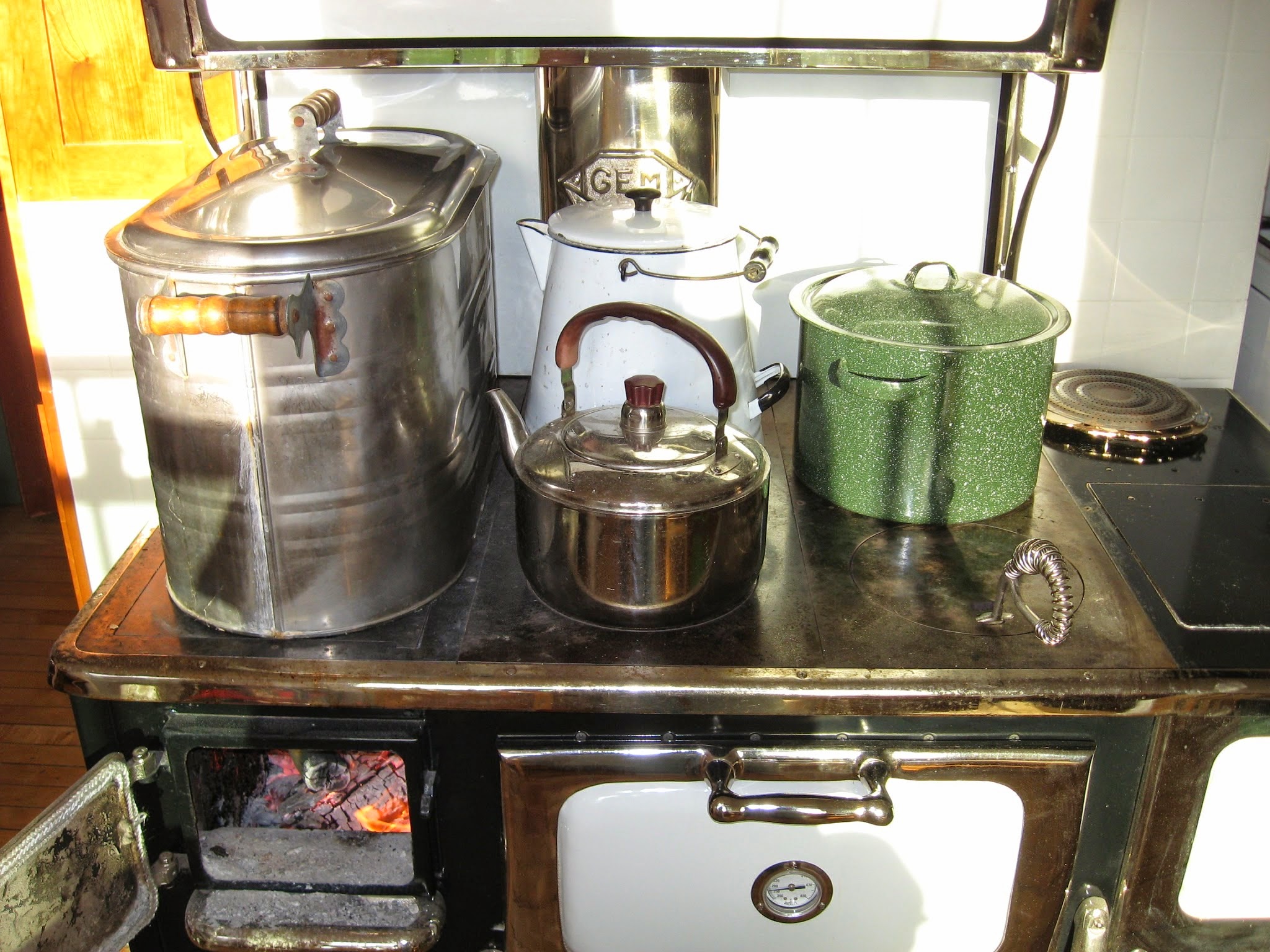
In the autumn of 2019, we didn't turn off our electric water heater and make the annual switch to wood heated water and daily firing of the Margin Gem until October 11. Well, the fall of 2020 has been much cooler here, and with the economic uncertainties of the world today, it seemed prudent to make this transition much earlier. Thus, we turned off our electric hot water heater on August 30 of this year, and with the exception of running it again for an hour and a quarter on Labor Day, which happened to be hot, all of our water has been heated by the Margin Gem since then. And because the Margin Gem has been fired daily, the vast majority of our cooking has been done on it too. This is the earliest we've ever made that transition, and the monetary savings has already been borne out in our most recent electric bill.
This got me to thinking about wood cookstove economics. If you don't have to pay for your fuel, the wood cookstove can be an enormous money saver. Yes, buying and installing a woodburning range is quite an investment, but as long as you can harvest and work up your own fuel, you begin to save money starting with the first fire you use in your range. In the face of dire economic circumstances, I think a woodburning cookstove can be a tremendous tool for making a household as cost-efficient as possible. Below you will find a list of some ways to take advantage of the money-savings a woodburning cookstove can provide. Links are provided to posts which go into more detail.
A). Use a Wood Cookstove to Heat Domestic Hot Water
Shutting off our electric hot water heater shaves a minimum of $20 from our electric bill each month. I figure that by the end of this calendar year, having our water heated by the Margin Gem will have saved us at least $1300 over the life of the system so far. This means that the extra cost of the range boiler, the water jacket, and the specialized plumbing has paid for itself, and there are many years of continued service left in them. If your water system and local codes will allow the installation of a range boiler system on your woodburning cookstove, I highly recommend it.
However, even if hot running water from your cookstove is not an option, heating water with your cookstove can be accomplished in a number of other ways. Most cookstoves have a water reservoir option for heating water that is manually drawn from the stove. In my experience, water heated in the range's reservoir is much hotter than the temperature at which most people would set their automatic water heaters. Thus, a water reservoir that only holds five gallons actually provides far more hot water than its capacity because the super-heated hot water will have to be tempered with additional cold water before it can be used.
In addition to a reservoir, water can be heated in vessels on top of the stove. The most commonly found is the
old-fashioned teakettle; its spout makes using the water from it quite convenient, too. You'd be surprised how many dishes can be washed and rinsed in a mere gallon of boiling water that has been diluted with cold water to a usable temperature. You may find it impossible to turn off your automatic water heater, but you can still save a little money by supplementing it with a little hot water here and there from your wood cookstove.
B. Take Advantage of the Home Heating Capacity of Your Woodburning Range
The woodburning cookstove can be a powerful heater. In fact, new ranges even come complete with BTU ratings and information about the number of square feet that they can heat. I'm kind of amused by that because when you look at old cookstove advertisements, the heating capacity of the range is never mentioned. Instead, they were always about the quality of the stove's construction, its fuel efficiency, and ALWAYS about its superior baking capabilities--even though history is replete with stories about cookstoves being the sole source of heat for many homes. Nowadays, advertisements tout the cookstove's heating capacity, but they don't say much about how well a stove can bake. Oh, the pendulum swings we see in life!
To maximize the heating capabilities of your woodburning range, keep the cooktop as free from extra kettles and miscellaneous as possible in order to let the heat radiate into the room. Open that oven door, too! The greater the surface area that is exposed, the greater the heat sent into the room.
Also, a strategically placed fan can move the heat through your house better, making you feel warmer when you are not standing right next to the stove. You can see our wood stove fan to the right on the Qualified Range below. For more details about getting the most heat from your wood cookstove, visit
this post.
C) Use Your Woodburning Range Instead of Your Small Kitchen Appliances
Conventional kitchen wisdom is that electric countertop appliances use less energy than utilizing your kitchen stove to accomplish the same cooking task. This is the complete opposite of what happens when your kitchen stove is a woodburning range. Here is a list of small electrics that can stay in the cupboard when the cookstove is in use:
The Electric Skillet
 |
French Toast cooking on the wood cookstove.
|
The Toaster
For a very lengthy post about the many ways you can toast bread on a wood cookstove, visit
here and
here.
The Microwave
In the pictures below, you can see me
using the warming ovens on both the Riverside Bakewell and the Margin Gem to soften or melt butter and to defrost homemade applesauce. Susan Fenoff, in her video about using wood cookstoves, calls the warming oven her "Amish microwave."
The Waffle Iron
The Slow Cooker or Crock Pot
There are actually many ways that you can use your cookstove as a slow cooker/crock pot, but the
method discussed in this post creates the most similar heat by using your wood cookstove's oven with the door open.
The Electric Wok
I don't know anyone with an electric wok anymore, but I know they exist. However, you don't need one because you can cook wonderful Oriental food in a
stovetop wok on a wood cookstove.
The Insta-Pot
I am almost afraid to point this one out since I know many people are in love with their Insta-Pots, but you can
use a pressure cooker on top of a wood cookstove quite easily. Sure, it won't do all of the things that an Insta-Pot can do, but you can pick up a cheap used pressure cooker in second hand stores very easily, and the food possibilities are endless and fast.
My favorite thing to cook in a pressure cooker is tougher cuts of meat, but you can quickly cook vegetables, rice, and even hot cereals in them.
The Popcorn Popper
The Deep Fat Fryer
Of course you have to be careful, but the wood cookstove is great for deep fat frying. Historically, wood cookstove cooks favored frying over baking because it is easier to control the temperature of the oil than the oven. In the picture above, you see homemade chicken nuggets frying on the Margin Gem, and in the post I wrote about them, I discuss
the details and cautions that are necessary to deep fat fry on a wood cookstove.
Some readers may look at the above points and note that specialized equipment is sometimes necessary. For example, in order to bake waffles on your wood cookstove, a stovetop waffle iron
is a requirement. They are increasingly hard to come by in antique stores, and the price has risen exponentially in the last twenty years. However,
new stovetop waffle irons are still available from Lehman Hardware, and at anywhere between $30 - $60, they are competitively priced with new electric ones. Stovetop waffle irons can be used on gas and electric coil-type modern ranges too, so they are not a bad investment when your countertop waffle iron gives up the ghost.
D. Use Your Wood Cookstove in Place of Other Non-Cooking Appliances
Your wood cookstove can do the jobs of other energy consuming appliances as well. Here is a list of non-cooking appliances that you can unplug:
The Scentsy® Warmer
Wonderful aromas can be sent wafting through your home by
simmering potpourri on top of your wood cookstove. You'd be amazed how many things resting quietly in your spice rack can be put to use as perfumes for your house without having to spend a ton of money on a ceramic warmer and individually packaged lumps of colored soy oil.
Still, if the colored lumps are your preference, you can melt them in a pan on the cool end of the range just as well as in the expensive warmers. The same can be said of candles in glass jars. When we get down to the bottom of a candle which has a scent we really enjoy, instead of lighting the candle, we just put the glass jar as far away from the fire as possible. The warmth of the stove still melts the wax so that it can emit the scent. Eventually, the aroma wears away and the candle can move onto its next stage of usefulness, but we've taken all possible advantage of its perfume. NOTE: Just be sure not to put any glass candle vessels where the heat of the fire is so intense that it could break the glass. That could be a disastrous fire hazard!
The Clothes Iron
I know, I know. Some of you are laughing because it's been years since you've ironed any clothes at all. Well, more power to you. But for those of us for whom ironing is still a very real chore,
ironing can still be accomplished with a wood cookstove as your source of heat. That's all I'll say about that here.
The Clothes Dryer
American households have to be the worst in the world about wasting energy to dry clothing. Oops! Sorry, I jumped up on one of my soapboxes there for a second. Seriously, though, a clothes rack placed near the wood cookstove can speed along the drying process for freshly laundered clothes. In the past, woodburning ranges were even equipped with rods for drying towels, mittens, and socks.
Cookstoves can still be used to cheaply and quickly dry clothes. The double advantage in this is that your can also unplug your home humidifier if you are hanging your clothes to dry indoors.
E. Eat Leftovers
Reducing food waste is one of the easiest things a household manager can do to save money. In the future, I hope to write a series of posts which give hints and recipes for making leftover foods into entirely new dishes. I will admit that reheating leftovers is the primary function of our microwave oven, but there are many more tasty ways that leftovers can be reheated or re-made using the wood cookstove. For example, instead of tossing mashed potatoes in the microwave and having them come out smelling unappetizing and looking no better, making mashed potato patties requires only a little extra effort, and the end product is three times as delicious.
Two posts that I already have which deal with leftovers include one about how to use
leftover roast beef and gravy that is very good. However, if you are really serious about stretching your grocery dollar, the most economical food discussed on this blog is definitely
pot-au-feu.
 |
A bowl of Pot-a-Feu.
|
Literally translated from the French, pot-a-feu means "pot on the fire." It is as delicious as you want it to be, it is never the same twice, and it is only feasible on a wood cookstove.
In short, to get the largest financial return from a wood cookstove, make it the energy center of the home. This is most certainly the way our ancestors used their kitchen ranges, and if one of today's households is blessed with a working wood cookstove, it still has every capability of serving in that capacity.
So, dear readers, what have I missed? Fill up the comments below with what you do, what you remember your ancestors doing, or what you have heard others did to save money with a wood cookstove. I'm anxiously awaiting your feedback.