Showing posts with label cookstove. Show all posts

Friday, October 16, 2020

Economizing with Your Wood Cookstove

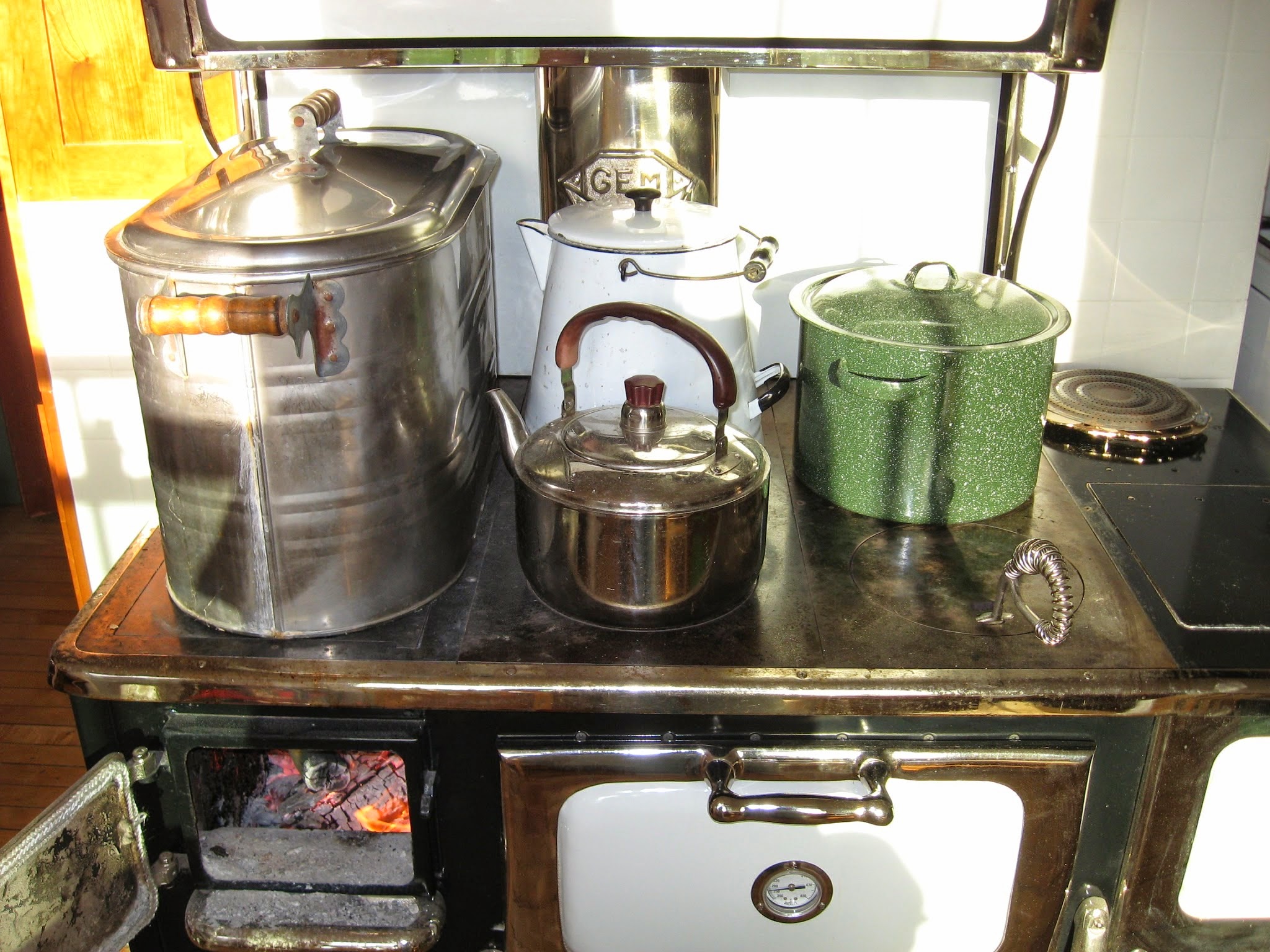
In the autumn of 2019, we didn't turn off our electric water heater and make the annual switch to wood heated water and daily firing of the Margin Gem until October 11.   Well, the fall of 2020 has been much cooler here, and with the economic uncertainties of the world today, it seemed prudent to make this transition much earlier.  Thus, we turned off our electric hot water heater on August 30 of this year, and with the exception of running it again for an hour and a quarter on Labor Day, which happened to be hot, all of our water has been heated by the Margin Gem since then.  And because the Margin Gem has been fired daily, the vast majority of our cooking has been done on it too.  This is the earliest we've ever made that transition, and the monetary savings has already been borne out in our most recent electric bill.

This got me to thinking about wood cookstove economics.  If you don't have to pay for your fuel, the wood cookstove can be an enormous money saver.  Yes, buying and installing a woodburning range is quite an investment, but as long as you can harvest and work up your own fuel, you begin to save money starting with the first fire you use in your range.  In the face of dire economic circumstances, I think a woodburning cookstove can be a tremendous tool for making a household as cost-efficient as possible.  Below you will find a list of some ways to take advantage of the money-savings a woodburning cookstove can provide.  Links are provided to posts which go into more detail.

A). Use a Wood Cookstove to Heat Domestic Hot Water

Shutting off our electric hot water heater shaves a minimum of $20 from our electric bill each month.  I figure that by the end of this calendar year, having our water heated by the Margin Gem will have saved us at least $1300 over the life of the system so far.  This means that the extra cost of the range boiler, the water jacket, and the specialized plumbing has paid for itself, and there are many years of continued service left in them.  If your water system and local codes will allow the installation of a range boiler system on your woodburning cookstove, I highly recommend it.

However, even if hot running water from your cookstove is not an option, heating water with your cookstove can be accomplished in a number of other ways.  Most cookstoves have a water reservoir option for heating water that is manually drawn from the stove.  In my experience, water heated in the range's reservoir is much hotter than the temperature at which most people would set their automatic water heaters.  Thus, a water reservoir that only holds five gallons actually provides far more hot water than its capacity because the super-heated hot water will have to be tempered with additional cold water before it can be used.


In addition to a reservoir, water can be heated in vessels on top of the stove.  The most commonly found is the old-fashioned teakettle; its spout makes using the water from it quite convenient, too.  You'd be surprised how many dishes can be washed and rinsed in a mere gallon of boiling water that has been diluted with cold water to a usable temperature.  You may find it impossible to turn off your automatic water heater, but you can still save a little money by supplementing it with a little hot water here and there from your wood cookstove.


B. Take Advantage of the Home Heating Capacity of Your Woodburning Range

The woodburning cookstove can be a powerful heater.  In fact, new ranges even come complete with BTU ratings and information about the number of square feet that they can heat.  I'm kind of amused by that because when you look at old cookstove advertisements, the heating capacity of the range is never mentioned.  Instead, they were always about the quality of the stove's construction, its fuel efficiency, and ALWAYS about its superior baking capabilities--even though history is replete with stories about cookstoves being the sole source of heat for many homes.  Nowadays, advertisements tout the cookstove's heating capacity, but they don't say much about how well a stove can bake.  Oh, the pendulum swings we see in life!

To maximize the heating capabilities of your woodburning range, keep the cooktop as free from extra kettles and miscellaneous as possible in order to let the heat radiate into the room.  Open that oven door, too!  The greater the surface area that is exposed, the greater the heat sent into the room.

Also, a strategically placed fan can move the heat through your house better, making you feel warmer when you are not standing right next to the stove.  You can see our wood stove fan to the right on the Qualified Range below.  For more details about getting the most heat from your wood cookstove, visit this post. 


C) Use Your Woodburning Range Instead of Your Small Kitchen Appliances

Conventional kitchen wisdom is that electric countertop appliances use less energy than utilizing your kitchen stove to accomplish the same cooking task.  This is the complete opposite of what happens when your kitchen stove is a woodburning range.  Here is a list of small electrics that can stay in the cupboard when the cookstove is in use:

The Electric Skillet
French Toast cooking on the wood cookstove.

The Toaster

For a very lengthy post about the many ways you can toast bread on a wood cookstove, visit here and here.

The Microwave

In the pictures below, you can see me using the warming ovens on both the Riverside Bakewell and the Margin Gem to soften or melt butter and to defrost homemade applesauce.  Susan Fenoff, in her video about using wood cookstoves, calls the warming oven her "Amish microwave."


The Waffle Iron


Waffles are delicious, but waffles cooked on a wood cookstove are a step above in my opinion.


The Slow Cooker or Crock Pot

There are actually many ways that you can use your cookstove as a slow cooker/crock pot, but the method discussed in this post creates the most similar heat by using your wood cookstove's oven with the door open.

The Electric Wok

I don't know anyone with an electric wok anymore, but I know they exist.  However, you don't need one because you can cook wonderful Oriental food in a stovetop wok on a wood cookstove.

The Insta-Pot

I am almost afraid to point this one out since I know many people are in love with their Insta-Pots, but you can use a pressure cooker on top of a wood cookstove quite easily.  Sure, it won't do all of the things that an Insta-Pot can do, but you can pick up a cheap used pressure cooker in second hand stores very easily, and the food possibilities are endless and fast.


My favorite thing to cook in a pressure cooker is tougher cuts of meat, but you can quickly cook vegetables, rice, and even hot cereals in them.

The Popcorn Popper

You'll need a very hot fire, but you can easily pop popcorn on top of a woodburning cookstove, and don't worry about having a fancy hand-cranked popper.  You can get popcorn that is every bit as delicious by shaking it in a plain old saucepan.

The Deep Fat Fryer

Of course you have to be careful, but the wood cookstove is great for deep fat frying.  Historically, wood cookstove cooks favored frying over baking because it is easier to control the temperature of the oil than the oven.  In the picture above, you see homemade chicken nuggets frying on the Margin Gem, and in the post I wrote about them, I discuss the details and cautions that are necessary to deep fat fry on a wood cookstove.

Some readers may look at the above points and note that specialized equipment is sometimes necessary.  For example, in order to bake waffles on your wood cookstove, a stovetop waffle iron is a requirement.  They are increasingly hard to come by in antique stores, and the price has risen exponentially in the last twenty years.  However, new stovetop waffle irons are still available from Lehman Hardware, and at anywhere between $30 - $60, they are competitively priced with new electric ones.  Stovetop waffle irons can be used on gas and electric coil-type modern ranges too, so they are not a bad investment when your countertop waffle iron gives up the ghost.

D. Use Your Wood Cookstove in Place of Other Non-Cooking Appliances

Your wood cookstove can do the jobs of other energy consuming appliances as well.  Here is a list of non-cooking appliances that you can unplug:

The Scentsy® Warmer

Wonderful aromas can be sent wafting through your home by simmering potpourri on top of your wood cookstove.  You'd be amazed how many things resting quietly in your spice rack can be put to use as perfumes for your house without having to spend a ton of money on a ceramic warmer and individually packaged lumps of colored soy oil.

Still, if the colored lumps are your preference, you can melt them in a pan on the cool end of the range just as well as in the expensive warmers.  The same can be said of candles in glass jars.  When we get down to the bottom of a candle which has a scent we really enjoy, instead of lighting the candle, we just put the glass jar as far away from the fire as possible.  The warmth of the stove still melts the wax so that it can emit the scent.  Eventually, the aroma wears away and the candle can move onto its next stage of usefulness, but we've taken all possible advantage of its perfume.  NOTE: Just be sure not to put any glass candle vessels where the heat of the fire is so intense that it could break the glass.  That could be a disastrous fire hazard!

The Clothes Iron

I know, I know.  Some of you are laughing because it's been years since you've ironed any clothes at all.  Well, more power to you.  But for those of us for whom ironing is still a very real chore, ironing can still be accomplished with a wood cookstove as your source of heat.  That's all I'll say about that here.

The Clothes Dryer


American households have to be the worst in the world about wasting energy to dry clothing.  Oops!  Sorry, I jumped up on one of my soapboxes there for a second.  Seriously, though, a clothes rack placed near the wood cookstove can speed along the drying process for freshly laundered clothes.  In the past, woodburning ranges were even equipped with rods for drying towels, mittens, and socks.  Cookstoves can still be used to cheaply and quickly dry clothes.  The double advantage in this is that your can also unplug your home humidifier if you are hanging your clothes to dry indoors.

E. Eat Leftovers

Reducing food waste is one of the easiest things a household manager can do to save money.  In the future, I hope to write a series of posts which give hints and recipes for making leftover foods into entirely new dishes.  I will admit that reheating leftovers is the primary function of our microwave oven, but there are many more tasty ways that leftovers can be reheated or re-made using the wood cookstove.  For example, instead of tossing mashed potatoes in the microwave and having them come out smelling unappetizing and looking no better, making mashed potato patties requires only a little extra effort, and the end product is three times as delicious.

Two posts that I already have which deal with leftovers include one about how to use leftover roast beef and gravy that is very good.  However, if you are really serious about stretching your grocery dollar, the most economical food discussed on this blog is definitely pot-au-feu.

A bowl of Pot-a-Feu.

Literally translated from the French, pot-a-feu means "pot on the fire."  It is as delicious as you want it to be, it is never the same twice, and it is only feasible on a wood cookstove.  

In short, to get the largest financial return from a wood cookstove, make it the energy center of the home.  This is most certainly the way our ancestors used their kitchen ranges, and if one of today's households is blessed with a working wood cookstove, it still has every capability of serving in that capacity.

So, dear readers, what have I missed?  Fill up the comments below with what you do, what you remember your ancestors doing, or what you have heard others did to save money with a wood cookstove.  I'm anxiously awaiting your feedback.

Monday, August 5, 2013

Pardon My Soapbox: Summer Fuel Addendum

If you read my last post, you saw the picture below of a wheelbarrow full of summer fuel: sticks, corn cobs, bark, etc.


Most of this particular wheelbarrow full of fuel was just bits of wood that I had picked up here and there around our farm, the rest was contributed by my dear grandmother from what she picked up around her farm.

I want to tell you what just half of this fuel did last Saturday.

1. Cooked our casserole for noon dinner (a new recipe that I copied out of a magazine in my doctor's office while I waited for my bi-annual cholesterol maintenance appointment--which, by the way, went very well despite the bacon grease that I put in my potato soup).  This new casserole recipe had approximately 75 minutes of stovetop cooking time before it was put in a moderate oven for another 20 minutes.  Thus, it had a total of over an hour and a half of cooking time.  We didn't like it, so you won't see the recipe on the blog.

2. Sauteed zucchini from my sister-in-law for our vegetable side dish.

3. Baked a pan of from-scratch buttermilk biscuits made with buttermilk from our cow Bonnie.  As soon as the casserole was finished baking, I put it into the warming oven, threw a pile of little sticks on the fire and brought the oven up to over 400 degrees for the biscuits.

4. Boiled and canned three and a half pints of pancake syrup made from the drippings that we catch from beneath the caramel sticky rolls baked for the Monday Markets.  (I think that this is a great way to save on the expense of sugar.)

5. Heated water for scalding the Tattler canning lids.

6. Heated water in the teakettle and reservoir for washing the canning jars and a few other dishes.

7. Heated enough hot water to meet all of our needs for the rest of the day, including a nice hot shower for me before we went to town.

Yes, that's right, all of this on half of the pile of sticks and cobs and bark which could have easily been left to rot where they were! 

You see--here is the soapbox part--having a wood cookstove allows a person to take what would often be considered trash and use it productively and efficiently.  It's just one of the many aspects of owning a wood cookstove that I consider extremely advantageous. 

I just wanted you all to know about that.  Thanks, I feel better.

P.S. Don't worry.  I know about the scientific evidence available on the importance of rotting wood as habitat and food source for all manner of flora and fauna which are necessary in balanced ecosystems.  Rest assured, no ecosystems were irreparably harmed in the above activities.  We have PLENTY of rotting wood around here!

P. P. S. The other half of the fuel in the picture above was supplemented by some split pieces that you saw in the winter fuel picture to cook potatoes for our dinner while we were gone to church on Sunday morning, to make another new casserole (also not very good), and, of course, to heat water.  I did get another partial wheelbarrow of summer fuel later on Sunday afternoon to keep the stove going in order to bake three batches of cookies to sell today at the Monday Market.  Efficiency, efficiency!


Sunday, June 23, 2013

Cookstoves that We Saw on Vacation

Whenever we venture away from home, I'm always on the prowl for wood cookstoves.  Several days ago, Nancy and I returned from visiting her sister Susan and her husband in southeastern Iowa.  They are fantastic hosts, and Susan always thinks of new and interesting places to take us while we are in their corner of the state. This trip was no exception.

The first cookstove that I saw was at a place that is officially called "Shoppes on Wall Street."  Basically, the "shoppes" are four buildings of second-hand items on the north side of the town square in Seymour, Iowa.  Sitting right outside was the wood cookstove that you see in the following pictures.  I spent a great deal of time examining her and dreaming about how much fun it would be to have enough money (or know-how) to restore her.

I could find no identifying mark for a brand name--which was disappointing--but I did get to learn a little about wood cookstoves that are designed this way.  This is the third wood cookstove that I have seen with the oven up high on the right side.  The first one that I ever saw like this is located at the Machine Shed Restaurant in Urbandale, Iowa.  It is used as a storage cabinet in the dining room of the restaurant where the wait staff keep things like jelly packets.

I spotted the second one online at antiquestoves.com.  It just so happened that we visited the proprietor of the business Mr. Semmelroth in Tekonsha, Michigan, on our summer vacation that year, and I got to see that restored stove in person in his storage garage.  It was beautiful and unique and very similar in color to the one you see below.


I think that the design of these stoves is fascinating.  To begin with, I'm amused by the fact that stove designers of the time tried to copy the high side oven design that was so popular with gas, electric, gasoline, and oil ranges of that time.  It would be pretty nice to not have to bend over so far to see into the oven.  My theory about why this design fell out of style is that the high side ovens generally needed to be smaller than ovens which were located beneath the cooktop in order to keep the width of the range within reason.
 
The oven door open.
 You can see in the picture above that the oven is not very wide since that is a standard size business envelope resting on the oven rack--which by the way is upside down and backward.  You can also see that under the stuff on top of the oven, there are two stove lids.  Clearly, you would have been able to cook on the surface above the oven since it theoretically would have been equivalent in heating capacity to the two stove lids which would be farthest away from the firebox in a regular style wood cookstove.

The firebox (sans ashpan) on the left and the warming oven on the right.
Another thing that was interesting about this stove was the location of the warming oven.  As you can see in the picture above, it was just to the right of the firebox.  Since this is the location of the baking oven on most stoves, I wonder just how warm this space would have gotten.  Note the water pipe just below the grate shakers.  I'm not sure how the stove heated water, but this pipe was connected to some kind of spigot which exited the stove next to the draft on the left side of the stove. 


I didn't get to look at the flue path very well because the stove was full of all manner of material that rodents had drug into it in order to make it into a suitable condo for their kind.  Therefore, I don't know whether the smoke and heat from the fire would have been first routed to the bottom of the oven and then up, around and out, or if everything would have run up the left side of the oven, across the top, down the right side, along the bottom and then out.  
 
While doing the research for this post, I ran across an entry on eBay with the following picture.  Perhaps the stove in the pictures above is a Belknap and Perfecto from about 1940.  This page from the catalog can be yours by visiting eBay here.


 Maybe someday I will know more about these fascinating ranges.
 
Anyway, we then saw a very cute and pretty small cream and green cookstove at Forbush Artiques.  Unfortunately, we didn't have our camera with us, so we didn't get any pictures of that cookstove.
 
On the Monday that we were there, we traveled further east and visited Gingerich Stoves and Plumbing, an Amish stove shop.  Gingerich's sells Margin Stoves, Ashland Stoves, and Kitchen Queen cookstoves.  There I was surprised to see that the Kitchen Queen cookstove actually comes in two sizes.  They had both sizes in their showroom.  While I was looking online to see if I could find information about the two sizes, I also discovered that at antiquestoves.com they are currently offering a limited edition of the Kitchen Queen in green and cream enamel, also.
 
As always, please leave a comment if you can add information about the content of my blog posts.  Thanks!

Friday, May 31, 2013

An eBay Find

I continually troll about on eBay looking at the woodburning cookstoves that are for sale there, and I ran across a surprise the other day: the exact same model cookstove that Nancy's grandparents started keeping house with when they were first married in 1938.  Rue and Ruth purchased this stove with some of the money that Ruth had saved from her four years as a country school teacher.  They purchased this stove from Montgomery Ward's, and it was their sole means of cooking until sometime in the early 1950s.

The same model stove as Rue and Ruth's for sale
on eBay.
Rue and Ruth's stove is now in our possession.  It is not in quite as good a shape as the one in the picture, but I think it is more complete because the handle on the front left door is still connected.  We hope to have it restored someday.

The stove in the picture can be seen here.  The eBay description says that it was still in regular use this year.  Pretty good record, I'd say.

I want to transfer the other pictures to this blog post to keep as a record.


Saturday, January 19, 2013

Maintaining an Even Oven Temperature in a Wood Cookstove, Part 1


How the Oven on a Wood Cookstove is Heated


One of the most common questions that people ask me about cooking on a woodburning cookstove is how to maintain an even oven temperature.  I think that this question is so popular for two reasons: a) people have heard all manner of folklore about temperamental cookstove ovens and b) though it was once as common a skill as combing one's hair, people no longer have the foggiest ideas about how to control a wood fire.  Trust me when I say that baking in a wood cookstove is really not that difficult.  It is, however, a topic that is complicated to write about, so this is the first of a series of posts about how to manage the oven of a woodburning cookstove.

As with many aspects of cooking with a woodburning range, each experienced wood cookstove cook will develop a sytem which works best for him or her.  All I can do here is share what I know works for others and for me, knowing that each stove and chimney behaves differently than the next.  To begin with, though, it seems like it is necessary to first discuss how a wood cookstove oven heats.

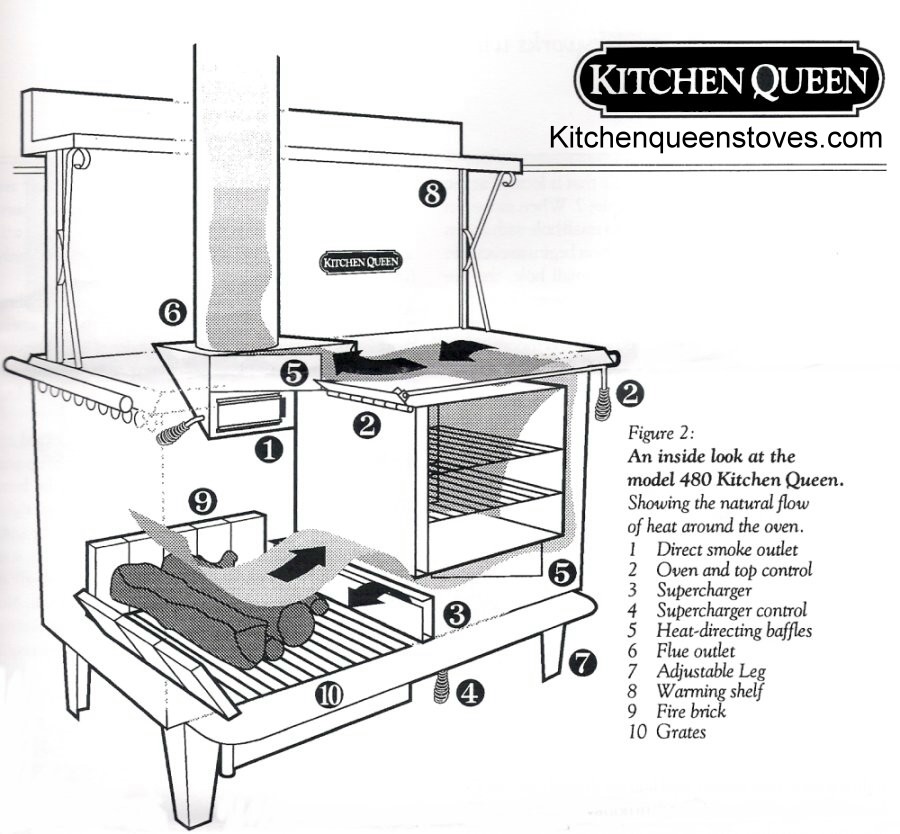
As far as I know, what I'm about to tell you is true about all of the cookstoves being manufactured today with the exception of the the Vermont Bun Baker (or Baker's Oven), the Kitchen Queen, and Enterprise-Fawcett's reproduction Queen Cook.   The Vermont Bun Baker's firebox sits squarely above its oven, and from what I've read, the heat and smoke from the fire are routed down around the oven before exiting via the flue.  The Kitchen Queen and the Queen Cook are both designed so that their ovens are heated from the bottom.

The Vermont Bun Baker.  Photo from
www.vermontwoodstove.com


A drawing of the Kitchen Queen wood cookstove which
shows the flue path when it is in the baking mode.  Photo
from www.kitchenqueenstoves.com.

Enterprise-Fawcett's Queen Cook.  The
oven is the box at the rear with the nickel-plated
image of Queen Victoria on it.  Photo from
www.farmallclub.com.

To the best of my knowledge, all the rest of the woodburning cooktoves which are being manufactured today are designed in basically the same way.  Furthermore, this design has been standard in woodburning ranges since the last two decades of the nineteenth century.   From everything that I have seen or read about the new cookstoves on the market currently, the major differences between the stoves of today and the stoves of yesteryear are mostly due to adjustments in the fireboxes, draft systems, and cosmetic appearances.

Generally, the firebox is on the left side of the stove, and the oven damper is located in the middle rear of the stove just under the stovetop.  The oven damper is a little door which, when open, allows smoke and heat to travel in the most direct route possible from the fire and up the chimney.  When closed, the oven damper forces the smoke and heat to flow around the oven before exiting the stove, thus heating the oven.

The following picture is a scan of p. 283 of John Vivian's 1978 book entitled The New Improved Wood Heat, which was illustrated by Liz Buell and published by Rodale Press.  All of the wood cookstoves that I have worked with, cooked on, or fully examined (over a dozen) were configured in the manner illustrated in the top design.  The only difference is that the three cookstoves that I have cooked on regularly here at home--the Margin Gem, the Qualified, and the Riverside Bakewell--all have a baffle centered under the oven.  This baffle extends from the back of the stove to about half way to the front of the stove, forcing the smoke and heat to travel under the oven and toward the front of the stove before taking a left and traveling to the back of the stove and then out the stovepipe.


Liz Buell's illustrations from John Vivian's book The New Improved
Wood Heat.  The shaded strips represent the path that heat and smoke
take around the oven in a cookstove when the oven damper is closed.
The photos below show the oven damper lever on the left side of the Margin Gem, and the middle rear lid of the Margin Gem cooktop is removed to show the actual oven damper itself.

A picture of the left side of the Margin Gem.  The
oven damper lever is the one with the black knob
on the end of it next to where the top water pipe
exits the waterjacket.  When the lever is down like
this, the oven damper is open.

The Margin Gem's oven damper in the open position so that
smoke and heat can go directly up the chimney.


This picture from the post entitled "Perfect Roast
Beef from Your Wood Cookstove" shows the oven
damper lever in the up position.  This means that the
damper is closed and the oven is heating.

The Margin Gem's oven damper in the closed position, forcing
all of the heat and smoke from the fire to be diverted around the oven.

Now, we are very happy with the Margin Gem for many reasons, but one feature of the Qualified range that I miss is that it had a sliding oven damper.  The Riverside Bakewell range down in the summer kitchen is equipped with a sliding oven damper as well.  I prefer the sliding oven damper over the levered oven damper because you can decide how widely you'd like the oven damper to be open.  The following pictures are of the oven damper of the green and cream Riverside Bakewell in various positions.
Riverside Bakewell cookstove's oven damper handle in the "open"
position.

The middle "French plate" or "blank plate" is removed to show
the oven damper in the open position. 

The oven damper handle in the partially closed position.

The oven damper on the Riverside Bakewell partially closed.


The oven damper handle in the position "to bake."

The Riverside Bakewell's oven damper closed for baking.
The Margin Gem's oven damper is either closed or open; there is no in between.  While I do like the added flexibility and control of the sliding oven damper, it is important to note that I have not been inconvenienced at all by the Margin Gem's style of oven damper either.  Many old stoves were manufactured with the same style of hinged oven damper, and I've never read of anyone clamoring about it as much as I just have.  Furthermore, you can also see that when the oven damper is open, the hole that it creates is really not that large, so some smoke and heat still always travel around the oven to exit the stove.

I am surprised at the variety of places that oven damper levers are found on different woodburning cookstoves.  I've taken the liberty of drawing a cookstove with arrows pointing to the various places where I've seen oven damper levers placed.

Each arrow shows a location where the oven damper has been located on
wood cookstoves that I have seen.

Hmmmm.  I suspect that the aforementioned John Vivian might have artistic abilities which are about as poor as mine, thus causing him to have collaborated with Liz Buell for his book's illustrations.  I'm thoroughly embarrassed that all of you now know the limited extent of my talent in the field of visual arts.

The Waterford Stanley cookstove seems to have a pretty unique baffle and damper system which operates on the same basic principles as I have recorded here, but it is manipulated by using a lever in notched dials on the cooktop itself.  A good place to see how all of that works is at a website called Granny Miller.  You can see the article here.

Now that you know how the heat from the fire gets to the oven of a woodburning cookstove, stay tuned for posts on how to control the heat.

Quick Links:  Maintaining an Even Oven Temperature in a Wood Cookstove, Part 2 Variables

Maintaining an Even Oven Temperature in a Wood Cookstove, Part 3: What Other People Do

Maintaining an Even Oven Temperature in a Wood Cookstove, Part 4: What I Do

Sunday, December 30, 2012

The Difference Between a Cookstove and a Range

I have been preparing a post (actually, what may become a series of posts) about regulating the heat of a wood cookstove's oven.  During my research, I was reminded of a technicality that I think perhaps I ought to address, especially since I always say that I want this blog to be about "all things cookstove."

I always use the word "cookstove" to denote a stove which is used for cooking and is fueled by wood or coal.  This is a common use of the word, and most people know exactly what I mean when I use the word this way.  However, our ancestors used this word to indicate only the small stoves which looked like the picture below.  The Original Fannie Farmer 1896 Cook Book notes that the ovens on these stoves could usually be opened from both sides.  One of the oven doors is open in the picture below.  The door to the upper left of the oven door would have been one way to access the firebox, which jutted into the top left area of the oven.

Photo from amberghistory.org

 A kitchen "range" was so named because of the larger range of different heat levels that it allowed the cook.  A range, or "set range," was a built-in affair which usually had its firebox in the center.  Ovens would appear on each side of the firebox, or might appear above the cooktop altogether, as in the picture below. 

Photo of a range at the Culinary Arts Museum in Providence, RI,
from abetterbagofgroceries.com
In 1896, Fannie Farmer wrote: "Set ranges, as they consume so large an amount of fuel, are being replaced by portable ones."  She further states that "A portable range is a cooking-stove with one oven door."  Thus, what I am always referring to as a cookstove is technically a "portable range."

Enterprise-Fawcett's Monarch Range.  This picture
is from their website: www.enterprise-fawcett.com.
This is a "portable range."
Something tells me that I might have a hard time convincing the four men who helped us move the Margin Gem into our kitchen that it is "portable."  I'm going to continue to refer to the portable range as a cookstove, and you'll all just have to forgive me for being technically incorrect. 

Phew!  I'm glad we've got this all cleared up.