Showing posts with label vintage cookstoves. Show all posts

Saturday, April 15, 2023

Cole's Hot Blast Ranges and Cookstoves

In my occasional trollings through Ebay, I sometimes run across some interesting cookstove ephemera that I want to share here on the blog. Tonight, we have a catalog from the Cole Manufacturing Company of Chicago, Illinois.  There is not date on the catalog, and a search of the Internet did not yield much information about this particular stove company at all.  However, I did find a site that said that the company closed down around 1920.  That information coupled with images from their 1916-1917 catalog, which was for sale at a different antique site, cause me to date this catalog at around 1920, thus making it one of the company's last.

The cover of the Cole catalog.

I've blown up the next view large enough that I think you'll be able to read it yourselves.  I'm entertained by the text on the left side and wonder whether there was some kind of "energy crisis" at the time that caused the price of coal to skyrocket like the price of heating oil did last fall.  There may not have been anything like that going on, though, as fuel economy is a topic often addressed in sales brochures for wood/coal cookstoves no matter the date of their publication.


Now, the next pictures are the ones that really caught my eye for this brochure.  Anytime I see a model of wood cookstove with the oven located somewhere other than the traditional spot to the right or left of the firebox, I am intrigued.  Before purchase, I think I had only seen a picture of the model on the left, and I couldn't help but think that this stove must have been a source of great frustration to those gallant souls who tried to cook on its stovetop.  You will note the barrel-shaped firepot at the base with four cooking lids arranged over its top.  This configuration is quite similar to the old-fashioned "laundry stoves" that were used to heat a pair of wash boilers before that advent of hot-running water.  

When I was in my very early teens, I purchased one of those laundry stoves at an antique store and hooked it up to an abandoned flue in the old school bus carcass that used to be here on our farm.  My brother and I had many, many fires in that stove while we cooked a variety of grass soups, popped field corn, and various other concocted "foods."  Although we never cooked any real foods on that stove, one of the things I learned quite quickly was that it didn't have the range of cooking temperatures that the surface of a cookstove has.  It was hottest over the center of the firepot, but beyond that, each of the four lids were of equal temperature.

I'm sure it would have been the same across the cooktop of the stove in the left picture.  The cook would have had to employ a variety of trivets and heat diffusers to create the varied temperatures that are needed for cooking most meals.  You may even notice that the text brags about this cookstove's room heating ability more than its ease of use for cooking.


The cookstove on the right in the scan above seems to have the answers to all of my suspicions about the one on the left.  You can see in the picture below, that the firebox is only at the front part of the base, thus creating a cooler surface at the back of the stove.  Granted, this still would have been a bit of a challenge because it wouldn't have been a lot cooler than the two front lids which are directly over the firebox, but some temperature difference would have existed.


Though this cookstove only had four cooking lids, I wonder if the high oven would have been bigger than the ovens on the little cookstoves that engineered like the one below.  I would think that it would certainly have been more even-heating with the flue gases hitting it squarely in the bottom rather than having the firebox occupy about a quarter of the surface area of the oven box.


That said, I wonder if "Cole's Square Base High Oven Range" would have been a popular choice with apartment dwellers of that time period.  This stove would have had a nice sized square oven while occupying a much smaller footprint in the kitchen than standard style range.

Speaking of standard style ranges, I find the range on the right side of the scan below to be extremely attractive.  The clean lines and angular trim just scream 1918 or 1919, and I think it is beautiful.  I might even use the word "masculine" to describe its solid, reliable appearance.


The next pages are interesting because they show Cole's line of "down-draft ranges."  As you can see, the Cole Manufacturing Company had designed a range where the drafts delivered air into the top of the firebox (hence the name "Hot Blast").  They advertise that this new technology is what allows their ranges to be so fuel-efficient.  What fascinates me about this is that delivering air into the top of the fire has been proven to create the most efficient combustion of wood, but not necessarily coal.  For this reason, the Margin Gem and other wood cookstoves that are being manufactured today use this technology, but they tout it as something that was discovered within the last thirty years.  It appears that the Cole Manufacturing Company was far ahead of its time.  

As you can see, Cole's offered three styles of downdraft ranges.
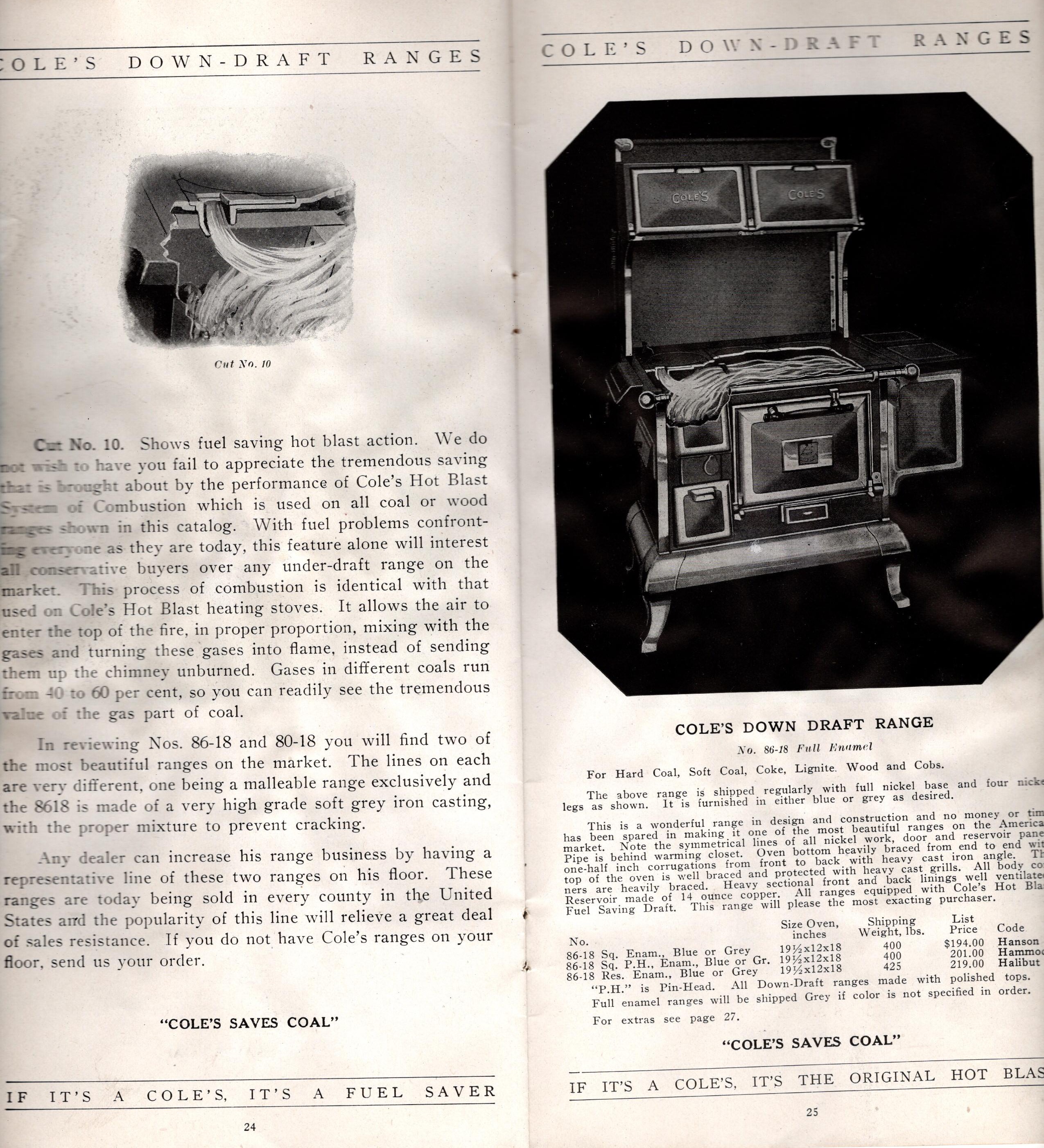


The rest of the catalog features their heating stoves, furnaces, and schoolhouse heaters--most of which feature the down draft air delivery system.  I would love to know what caused this company to close its doors so long before the Great Depression hit, so if you have any information to add, please do so in the comments section below.


Monday, February 22, 2021

Enterprise Stoves from the Phillips & Buttorff Corporation of Nashville, Tennessee

I thought I'd share one of my 2020 Christmas present with all of you.  This stove catalog is from the Phillips & Buttorff Corporation of Nashville, Tennessee, and lists all of their coal and wood ranges, stoves, and heaters.

It has been very difficult to find information about the Phillips and Buttorff Corporation anywhere on the internet.  What little I've found says that when Henry W. Buttorff, who was born in 1837, came of working age, he started as a sheet metal apprentice and worked his way into being a leading businessman in the state of Tennessee.  The Phillips & Buttorff Manufacturing Corporation was incorporated in 1881 but had been in business as Phillips, Buttorff & Company for several years before that.   


There is no date anywhere in this catalog, but my best guess is that it dates from 1946 - 1950.  I base this on the following evidence:

a) The style of stoves shown in the catalog.
b) The font styles used for the text.
c) Page 1 identifies this as catalog "T."


My research uncovered that Catalog "H" came out in 1932.  If a single catalog were published each year, Catalog "T" should have come out in 1944.  However, we all know that World War II stopped stove production in the U.S. since all foundries were retooled to produce munitions or other products needed for the war.  

The catalog does say that Phillips & Buttorff also produced a complete line of electric and gas stoves at the time it was published.  During my research, I found several pictures of Enterprise gas stoves from this company, some of which looked as though they were produced in the 1960s.  I was not able to find any information about the company's end, though.

Before you take a look at the pictures below, let me say that I was initially confused about this catalog because I expected it to depict the Enterprise stoves which were manufactured in Canada.  I now know that the Canadian Enterprise stove line was manufactured by Enterprise Fawcett in Sackville, New Brunswick, and had no connection that I can find to the Tennessee company using the same branding.

Enough comments, Jim.  Let the pictures speak for themselves!


The ten-page gap here is because the omitted pages all had to do with their heating stoves.


The page above, my friends, is the type of thing that caused me to start this blog.  Notice how scant the directions really are.


If any of my readers has a Phillips & Buttorff Enterprise stove, please comment below about your experiences with it.  Also, if anyone who reads this knows more about the Phillips & Buttorff Corporation, by all means, utilize the comments to let us all know more about this company!  

Friday, October 30, 2020

Link to a Great Cookstove Video

With the latest uptick in Covid-19 cases around here, I've taken to eating my school lunch alone in the classroom in which I am substituting to minimize my exposure.  And since I'm by myself, I watch Youtube videos while I eat.  Among other things, I watch whatever videos I can find about cooking on a wood cookstove, and I found a fantastic one this week.  

Cape Cod couple Tom and Lauren own and use an antique Herald C range made by O. G. Thomas in Taunton, Massachusetts.  They've had the range since the 1970s and had it restored in the 1990s.  Besides supplementing their home heating, the range does a lot of their cooking as it is conveniently located between their kitchen and living room.

The reason I'm excited to link to this video is because it contains excellent footage of the flue path around the oven, the oven damper, and the oven clean out door for this style of range.  I've mentioned before that the woodburning ranges which were manufactured in the Northeast are entirely different from those manufactured in the Midwest, and I've never seen a stove like this in person, so this video is an excellent resource for those of us who are unfamiliar with this style of stove.  The video contains several points of new learning for me, and I was totally fascinated.

The first thing that caught my attention was the tool that he demonstrates at 00:39.  I've never seen something that could lift the "T" and the two lids over the firebox at once.  I might have to put one of these on my Christmas list sometime for use on the Hayes-Custer!

The second surprise for me was at 1:22 when we get to see the oven clean out door.  I did not know that some of these were located so that they opened into what is called the "hearth" on this style of stove.  It seems to me like this would be a much cleaner way to remove the soot from the flue path around the oven than having the door open at the front of the stove.

Starting at 2:00, you can see the flue path around the oven.  In the diagram's below from John Vivian's book Wood Heat, you can see two flue paths.  I'm used to the version on the top, but the video shows an excellent version of the lower design.

The oven damper is demonstrated at 3:28, and I've never seen another one like it.

At 14:10 Tom does an excellent job of explaining the function of the check draft on the upper left side of the firebox, too.  To me, this is one of the most informative Youtube videos I've ever seen about a wood cookstove.

So after all of that advertising, here is the link:

https://www.youtube.com/watch?v=NkIXYG7GRzU&t=5s

Please do them a favor and hit the like button on the video.  For bonus content, you can see them making a Cape Cod Clam Boil along with appetizers on the cookstove at this link:

https://www.youtube.com/watch?v=XfKriNvj1nw

I hope you all enjoy these videos as much as I did, and I'm very thankful for Tom's permission to link to them here.

Saturday, October 3, 2020

Crawford Ranges from the Walker & Pratt Company

I am fascinated by the fact that American wood and coal cookstove construction varied so much by geographical region.  As I scroll through the various antique ranges that are for sale on eBay (something I spend too much time doing), I can pretty much tell at a glance whether the stove was made in the Northeast, the South, or the Midwest.

One of the giveaway traits of cookstoves made in the Northeast is that they continued to make 100% cast iron stoves long after the strategic incorporation of steel infiltrated stove construction in other parts of the country.  I've been told that all-cast iron ranges last longer and are easier to repair than their partly steel contemporaries, and my personal observation is that they seem to have greater longevity as well.

The Walker & Pratt Manufacturing Company of Boston, Massachusetts, is one of those northeastern companies whose ranges are still commonly found today.  Try as I might, I am unable to find definite dates for when the Walker & Pratt Company began and ended their manufacture of stoves.  One thing that everyone who talks about them likes to mention, though, is that the company manufactured cannon balls and other ammunition during the Civil War.  Once again, no date is present anywhere in this circular, but judging from the women's fashion depicted, the print fonts used, and the styles of ranges advertised, my best guess is that it was printed circa 1910.  

I actually had the opportunity to see two Crawford Ranges in person at Living History Farms in Urbandale, Iowa.  You can read about them in this post.  The stoves shown in the circular below are considerably younger than those at Living History Farms, however.


Gabriel and Sarah Chrisman of Port Townsend, Washington, have a restored Crawford Range in use in their Victorian home.  You can read about the stove and watch a video of Sarah baking cookies in it at this link.

Someday, I hope to get the opportunity to cook on one of these fine ranges.  Until then, if any of my readers are Crawford Range owners and operators, by all means please fill up the comments with your thoughts about these beauties!  Any additional information about the Walker & Pratt Manufacturing Company would also be greatly appreciated.

Monday, August 31, 2020

Round Oak Stove Brochure

Honestly, I don't remember where I got this brochure, and to tell the truth, there is not a lot of information in it, but it is a neat little bit of history.

Mr. Philo D. Beckwith founded the Round Oak Stove Company in 1871 after about four years of building cast iron heating stoves.  Located in Dowagiac, Michigan, the company added cookstoves to its repertoire around 1900, reaching its peak ten years later.

No dates are present anywhere in this brochure, but from the fonts, the illustrations, and the stove styles, my guess is that the brochure dates from about 1910 - 1915.  It is written in the style of an advertising circular with the end of each stove description urging the reader to write the company and request their full catalog.  These little endings are unique examples of creative writing since they are all slightly different ways of saying the same thing.

"May we send you the large, illustrated Range Book?  It's free for the asking."
"May we send you the large, illustrated book?  It's free."
"The subject demands detailed proof.  May we supply it?  Sent free on your request."

Another interesting feature is that the front and back covers are equipped with pictures of animals with a sheet of tracing paper over them, and some aspiring artist in history has tried his hand at tracing them.  The ones in the front of the book are shown in the first scan below.

After a string of heating stove advertisements, the first picture of a range is shown below.  Each advertisement features a bit of heating stove history with an engraving and a blurb at the top.


I think the rectangular motif in the top corners, on the teapot shelves, and on the front of the firebox and reservoir give these stoves a very durable appearance.  They look like they were built to be workhorses, don't they?


The Round Oak Stove Company (also known as the Estate of P. D. Beckwith, Inc.) closed its doors in 1946, but several of their stoves are still in service today.